

Solar Panels Washington — Costs, Savings & Payback
The Real Cost of Waiting for Solar Panels in Washington
Puget Sound Energy, Seattle City Light increased rates 2–5% annually over the past decade, with a 8% hike this past year. While Washington's rate of $0.14/kWh is below average, 3.82 daily sun hours make solar panels in Washington financially viable — generating $1,800-$3,600 in annual savings for a typical household.
To give you a reliable picture, these estimates are built on strictly conservative assumptions: no expired incentives, includes ~4%/yr electricity rate increases (EIA historical avg), Full Retail NEM (1:1) — every exported kWh credited at full rate. While other sites inflate their numbers to close a sale, we show reality — so the savings you see here are savings you can actually count on.
Washington Solar Data at a Glance
Washington solar panels make financial sense in 2026 despite a below-average electricity rate of $0.14/kWh. The key driver: 3.82 daily sun hours and a 2–5%/year rate increase trend that makes every year of delay more expensive. Solar panels in Washington typically pay back in ~19 years.
Source: NREL Solar Radiation Database
Most Washington homeowners going solar in 2026 are looking at a gross investment of $45,000 – $90,000 — with returns competitive with the national average. The payback period is longer than high-rate states, but positive over 25 years. Washington's property tax exemption shields $15,000 – $25,000 in solar-added home value from reassessment.
Rates from EIA ($0.14/kWh), sun hours from NREL. All figures use real location data and already factor in a 4%/year compounded electricity rate increase — giving you a realistic picture you can actually plan with. Use our free Solar Calculator for a personalized ZIP-level estimate.
Data: July 2026
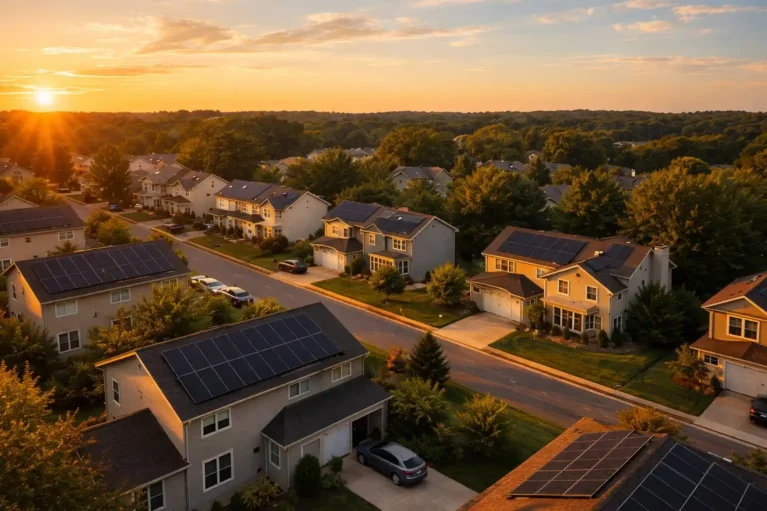
Why Solar Panels in Washington Make Financial Sense
- At $0.14/kWh, Washington's rate is below average — but 3.82 daily sun hours and a 2–5%/year rate increase trend still make solar panels Washington a sound long-term investment
- 3.82 peak sun hours daily — enough to consistently offset the majority of household electricity consumption with solar panels in Washington
- Washington exempts solar-added home value from property tax reassessment — your assessed value rises by $15,000 – $25,000 but you pay no additional property tax on that increase
- Full retail net metering means every exported kilowatt-hour from your solar panels in Washington earns a full credit at $0.14/kWh, maximizing year-round financial return
Washington law protects solar-added home value from property tax — your assessed value rises by $15,000 – $25,000 but you pay no additional property tax on that amount. NREL and SEIA data consistently show solar panels Washington delivering positive lifetime returns, particularly for Puget Sound Energy and Seattle City Light customers, where rates have climbed 2–5% per year — compounding over a 25-year system life. Use our Solar Calculator for your address. NREL research shows solar panels Washington retain 87–92% of their output after 25 years — meaning the Washington solar investment keeps delivering well beyond the payback window.
Top Solar Cities in Washington
| City | Peak Sun Hrs | Avg. Rate | Est. 25-Yr Net Profit* | Est. Payback |
|---|---|---|---|---|
| Seattle | 3.82 hrs/day | $0.14/kWh | $27,502 | 19 years |
| Spokane | 4.42 hrs/day | $0.09/kWh | $3,502 | 25 years |
| Tacoma | 3.55 hrs/day | $0.10/kWh | $-9,998 | 41 years |
| Bellevue | 3.57 hrs/day | $0.10/kWh | $-2,498 | 38 years |
*$200/month bill, south-facing roof. NREL + EIA data. Use our free Solar Calculator for your exact address.
Solar Panels Washington vs. US Average
| Factor | Washington | US Average | WA Advantage |
|---|---|---|---|
| Peak Sun Hours | 3.82 hrs/day | 4.5 hrs/day | -15% less |
| Solar Payback Period | ~19 years | 15 years (US avg) | 4 yrs slower |
| 25-Yr Net Profit* | $27,502 | $59,450 | $31,948 less |
| 25-Year ROI* | ~46% | ~147% (US avg) | -101% lower |
*$200/month bill reference. Sources: NSRDB (NREL), EIA.
While Washington's rate of $0.14/kWh is below the national average, 3.82 daily sun hours and a 2–5%/year rate increase trend make solar panels Washington a worthwhile long-term investment compared to other lower-rate states.

How Much Can a Washington Family Save with Solar?
Most Washington families save $1,800-$3,600 per year with solar panels. Homes with EV charging or high daytime loads benefit most from Washington solar — Puget Sound Energy customers benefit from retail NEM and steady rate escalation over the 25-year system lifetime.
Solar Incentives in Washington (2026)
Property Tax Exemption: Washington state exempts solar from property tax valuation. Puget Sound Energy and Seattle City Light customers benefit from a rising home value with no change to the assessed value or annual tax bill.
Net Metering: Washington offers full retail-rate net metering (1:1) — every kWh you export earns a full credit against your bill. Self-consumption rate: 100%. One of the strongest NEM policies in the US.Next Steps: Going Solar in Washington
- 1→Calculate your savings Use our Solar Savings Calculator to estimate your exact system size, cost, and payback for your Washington ZIP code.
- 2→Learn the basics New to solar? Our Solar Basics Guide covers how panels work, sizing, and what to expect before you get quotes.
- 3→Check your incentives Review the property-tax, sales-tax, and net-metering programs available in Washington in our Solar Incentives Guide.
- 4→Get dealer & installer quotes Compare pricing, financing terms, and whether the installer is registered for any Washington rebate program before you sign.
Washington Solar FAQ
Most homeowners save $1,800-$3,600 per year with solar panels Washington. At $0.14/kWh and 3.82 sun hours, solar panels Washington pay back in ~19 years and generate $65,627 – $131,253 over 25 years. Use our Solar Calculator for your ZIP.
A typical Washington home needs a 12–24 kW system (30–60 panels), costing $45,000 – $90,000 at 2026 prices. Washington's property tax exemption shields solar-added home value from reassessment. Use the calculator above for your exact numbers.
The federal solar tax credit (Section 25D, ITC) expired December 31, 2025 and is no longer available. Washington property tax exemption on solar-added home value. Washington exempts solar equipment from sales tax. Net metering: Full Retail 1:1 — Washington maintains full retail net metering. Every kilowatt-hour your solar panels Washington export earns a full credit at $0.14/kWh, significantly improving payback and 25-year ROI.
Solar in Nearby States
Electricity rates and sun hours vary by region — see how solar compares in neighboring states: Idaho and Oregon.
Curious how solar looks elsewhere? Check out the Solar by State hub →
Free Tools & Guides
Washington solar data sourced from U.S. EIA, NREL, and DSIRE. Last updated July 2026. Estimates are illustrative averages — use our free Solar Calculator for personalized results.