

Solar Battery Storage: Complete Guide to Home Backup Power (2026)
Power outages are increasing. Electricity rates keep rising. A home battery solves both — here's everything you need to know about solar battery storage in 2026: how it works, what it costs, and whether it makes sense for your home.
What Is Solar Battery Storage?
A solar battery stores excess electricity generated by your panels for use when the sun isn't shining. Instead of sending surplus power back to the grid during the day, you save it in a battery to power your home at night, during peak rate hours, or when the grid goes down.
Think of it as a backup generator that runs on your own clean energy — silent, automatic, and emission-free. Unlike a gas generator, a solar battery requires no fuel, no maintenance, and switches on in milliseconds rather than minutes.
Capacity (kWh) vs. Power Rating (kW): Know the Difference
Every battery has two separate specs that homeowners often confuse. Capacity (kWh) is how much energy it can store in total — this determines how long it can run your home. Power rating (kW) is how much electricity it can deliver at once — this determines how many things you can run at the same time. A battery with high capacity but low power can keep your fridge running all night but might not be able to start your air conditioner. When comparing batteries, check both numbers, not just the headline capacity.
How Solar Batteries Work
Charging: Storing Your Solar Power
During daylight hours your solar panels often produce more electricity than your home uses. Instead of sending that surplus to the grid for a small credit, your battery system captures it automatically — the battery management system monitors production and consumption in real time and stores whatever isn't immediately needed.
Discharging: Using Your Stored Power
Once the sun goes down — or when a power outage hits — the battery discharges to power your home. The inverter converts stored DC electricity back to AC, seamlessly taking over from the grid. The switchover happens in under 0.1 seconds — fast enough that most devices never notice the transition.
Smart Optimization
Modern battery systems use smart software to optimize when to store and when to use power. If your utility has time-of-use rates — charging more during peak hours — your battery software automatically learns to discharge during expensive peak times and recharge when rates are lowest. In California, this works out to roughly $70–$110 per kWh of battery capacity per year — about $945–$1,485/year for a 13.5 kWh battery cycled daily.
Benefits of Home Battery Storage
Backup Power When You Need It Most
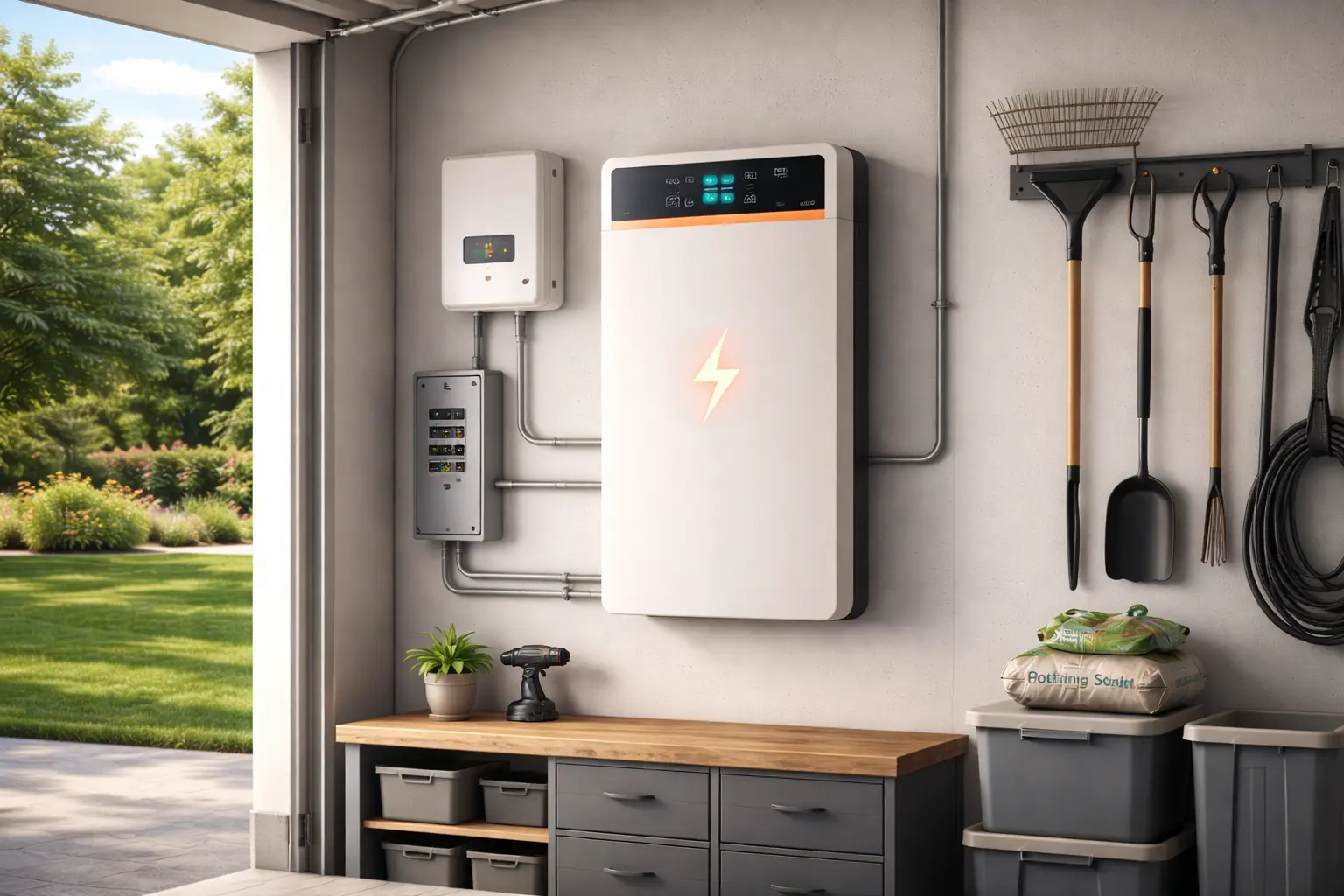
The primary reason homeowners install batteries is reliable backup power. When the grid fails, your battery keeps essential systems running automatically. A single 13.5 kWh battery can power these essentials for 10–24 hours:
- Refrigerator and freezer — prevent hundreds of dollars in spoiled food
- Medical equipment — CPAP, oxygen concentrators, refrigerated medications
- Internet and phones — stay connected and informed
- Heating and cooling — maintain safety in extreme temperatures
- Security systems — keep your home protected
- Lights and basic appliances — maintain normal routines
With solar panels recharging your battery each day, you can maintain power indefinitely during extended outages, while a gas generator would need constant refueling to do the same. Grid outages have increased dramatically — from 3–4 hours annually per customer in the early 2000s to over 8 hours in recent years.
Financial Returns Through Rate Arbitrage
In states with time-of-use pricing, electricity can cost 3–4× more during peak hours (typically 4–9 PM) than overnight. A battery charges at the low rate and discharges during the expensive window — the price difference goes straight into your pocket. Using the same ~$70–$110 per kWh per year figure from above, a larger 16 kWh battery can capture roughly $1,120–$1,760 per year in California on rate arbitrage alone.
Battery Costs in 2026
For most homeowners in TOU markets or outage-prone areas, batteries pay for themselves within 7–12 years through electricity savings and demand response programs. Every year after that, the savings are pure profit for the rest of the battery's life.
Prices are typical fully-installed averages (unit + inverter + labor) compiled from multiple 2026 installer and review sources — actual quotes vary by region, electrical setup, and installer. Warranty length depends on the model: most run 10 years, Enphase IQ Battery 5P runs 15.
Lifespan & Maintenance
Most lithium batteries last 10–15 years and require no hands-on maintenance beyond keeping the unit out of extreme temperatures; performance can be checked anytime through your inverter app. Lead-acid lasts only 3–8 years and needs more upkeep. See our Battery Types Guide for a full chemistry-by-chemistry breakdown of lifespan, cycle life, and efficiency.
Is Battery Storage Right for Your Home?
A battery makes the most sense if one or more of these apply to you:
- ✓Power goes out 2+ times per year or outages last several hours
- ✓You live in a wildfire zone, hurricane region, or area with aging infrastructure
- ✓Your utility charges significantly more during peak hours (TOU rates)
- ✓You already have solar or are adding solar panels
- ✓Your state offers rebates (CA SGIP, MD grant, NY utility rebates)
- ✓Someone in your household has medical equipment requiring power
Next Steps: Getting Battery Storage
- 1→Size your system Use our Battery Sizing Calculator to find the right capacity for your home's daily usage and backup goals.
- 2→Check available incentives Review state and utility programs in our Battery Incentives Guide — programs vary significantly by location.
- 3→Compare battery types Understand lithium vs. lead-acid chemistry tradeoffs in our Battery Types Guide before talking to installers.
- 4→Get 2–3 installer quotes Compare price per kWh of usable capacity, warranty terms, and software features. Most installations take 4–8 hours.
Battery Basics FAQ
Yes. Most modern solar systems can add battery storage through a retrofit installation. Your installer will verify compatibility with your existing inverter and potentially recommend an upgrade. Expect slightly higher costs for a retrofit than installing solar and battery together initially.
Most homes need 1–2 batteries (13–27 kWh total) for essential backup power. Whole-home backup or off-grid setups may require 3–4 batteries. Our Battery Sizing Calculator gives a personalized recommendation based on your daily usage and backup goals.
Yes — that's the primary benefit. When grid power fails, your battery takes over in under 0.1 seconds. Solar panels recharge it daily, allowing indefinite backup during extended outages.
No — a standalone battery can charge from the grid during off-peak hours and discharge during peak hours to reduce your bill. Note that the 30% federal tax credit (Section 25D) expired December 31, 2025 and no longer applies to standalone batteries. That said, pairing a battery with solar maximizes savings and provides true energy independence.
Round-trip efficiency is how much electricity you get back for every unit you put in. Lithium batteries return 90–95¢ for every $1 of electricity stored. Lead-acid batteries return only 70–80¢. The 10–25% difference adds up significantly over years of daily cycling.
Free Tools & Guides
Battery data sourced from U.S. EIA, U.S. DOE, and manufacturer specifications. Last updated May 2026.