

Battery Incentives 2026: What's Still Available After the Federal Credit Expired
Federal Battery Tax Credit: Expired December 31, 2025
There is no phase-down and no partial credit for 2026 installations. Homeowners who installed in 2025 can still claim it on their 2025 tax return via IRS Form 5695. The good news: state grants, utility rebates, demand response programs, and tax exemptions remain active in many states — see the sections below.
One exception exists: the commercial Section 48E credit remains available through 2032 for batteries owned by third-party leasing companies. If you lease rather than purchase, the leasing company claims the credit and may pass some savings as a lower monthly payment — but you don't own the system and can't claim any state incentives that require ownership.
State Battery Incentive Programs
After the federal credit expired, several states stepped in with their own direct battery programs. These fall into three types: upfront rebates paid per installed kWh, direct grants paid regardless of tax liability, and state income tax credits. Availability, funding levels, and eligibility rules vary significantly by state and change frequently — always verify with the program administrator before purchasing.
Utility Battery Rebates
Many utilities offer battery rebates entirely separate from state programs. These are territory-specific — only customers of that utility qualify — and funding resets with annual budget cycles, so availability can change year to year. Rebate amounts are typically paid per installed kWh of capacity.
Demand Response Programs
Demand response programs pay battery owners recurring annual compensation for allowing their stored energy to be dispatched during peak grid demand — typically summer weekday afternoons. Unlike one-time rebates, these payments continue each year for the life of the program, making them one of the most financially valuable battery incentives available. To find programs available at your address and enroll, check DSIRE or ask your installer — most enrollment is handled at installation time.
Sales & Property Tax Exemptions
Tax exemptions are among the most stable battery incentives — they are written into state law rather than funded from annual budgets, so they don't run out mid-year. Two types exist: sales tax exemptions reduce the purchase price of battery equipment, while property tax exemptions prevent the added home value from a battery from raising your annual property tax bill.
Will You Qualify for Battery Incentives?
Eligibility depends on program type, your state, and how you finance the system. Use this checklist as a starting point — then verify specific rules directly with the program administrator or your installer before purchasing.
- ✓You own the system — cash, solar loan, or HELOC all qualify. Leases rarely qualify.
- ✓Active program in your state — check DSIRE for your ZIP before assuming availability.
- ✓System is 3 kWh or larger — minimum capacity thresholds apply to most programs.
- ✓Licensed, permitted install — DIY installs rarely qualify for any incentive program.
- ✗You lease the battery — the leasing company owns it and claims available credits.
- ✗Funding exhausted — many state programs have waitlists. Check before buying.
- ✗Solar pairing required — some state and utility programs require existing solar.
- ✗No active program in your state — most US states lack a dedicated battery incentive.
Incentive programs change without notice — funding runs out, rules shift. Confirm current eligibility and deadlines at DSIRE for your ZIP code before signing a contract.
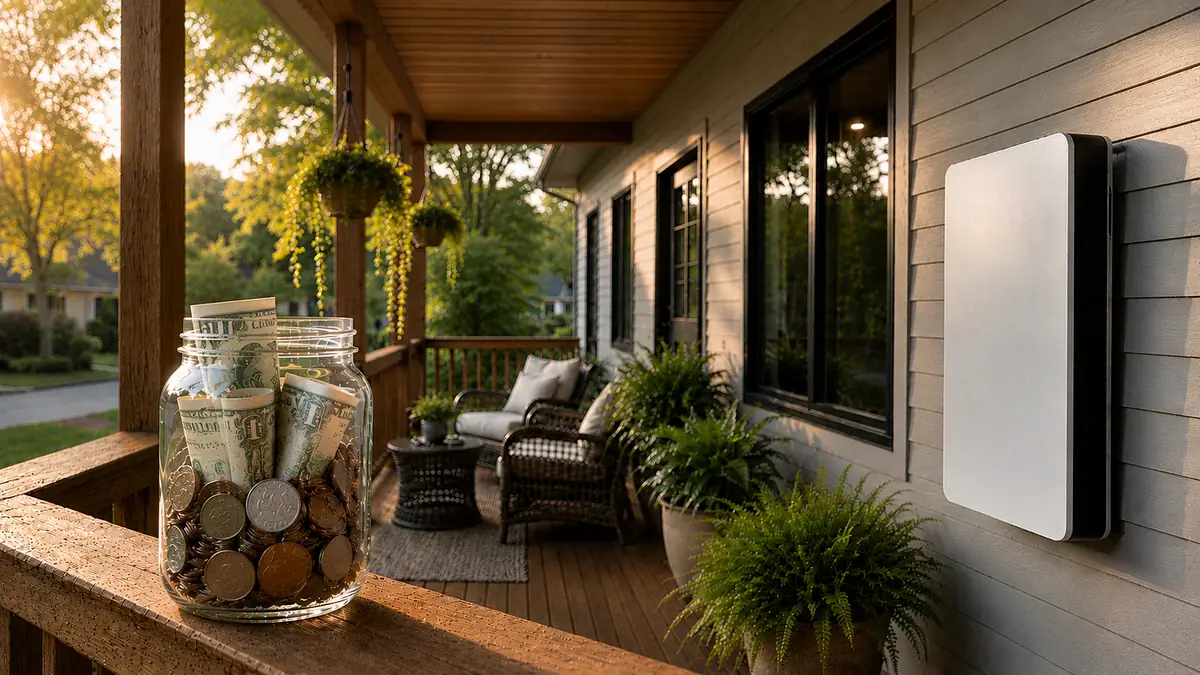
Is Home Battery Storage Still Worth It in 2026?
Without the federal credit, the financial case rests on four sources of value: electricity savings from self-consumption, rate arbitrage on time-of-use plans, demand response payments, and backup power. Battery storage makes the strongest financial sense when one or more of these applies to your situation.
- ✓Time-of-use rates — peak rates 2–3× higher than off-peak; storing cheap power generates roughly $70–$110 per kWh of battery capacity per year.*
- ✓Reduced net metering — where solar exports earn below-retail rates, a battery recaptures that lost value.
- ✓Demand response enrollment — annual payment program adds recurring income on top of electricity savings.
- ✓Outage-prone area — in wildfire zones or hurricane regions, backup power value alone justifies much of the cost.
- ✗Flat-rate electricity pricing — without time-of-use rates, rate arbitrage savings are minimal.
- ✗Reliable grid, rare outages — backup power value is lower when outages are brief and infrequent.
- ✗No state or utility incentive — without upfront subsidies, payback extends to 10–14 years in low-rate states.
- ✗Low electricity rates — below ~$0.14/kWh, per-kWh savings are too small to justify the upfront cost.
*Per-kWh, not a flat dollar amount — actual annual savings scale with battery capacity (e.g. a 13.5 kWh battery lands around $945–$1,485/year) and depend on your utility's specific peak/off-peak rate spread.
Estimate the right battery size for your home with our free calculator.
Battery Sizing Calculator →Battery Incentives FAQ
No. The Section 25D Residential Clean Energy Credit — which covered 30% of battery storage costs — expired December 31, 2025 under the One Big Beautiful Bill Act (OBBBA). There is no phase-down and no partial credit for 2026 installations. Homeowners who installed in 2025 can still claim it on their 2025 return via IRS Form 5695. One exception: the commercial Section 48E credit remains available through 2032 for batteries owned by third-party leasing companies.
Four types remain active in select states: state grants and per-kWh rebates, utility rebates, demand response programs that pay annually, and sales or property tax exemptions. Tax exemptions are the most stable — written into state law rather than funded from annual budgets. Always verify current status at DSIRE before purchasing.
It depends on the specific program. Some state and utility programs require solar pairing; others cover standalone batteries. Always verify the pairing requirement for any program you're considering — this is listed in DSIRE for each program. Ask your installer before signing a contract.
Yes — for programs requiring ownership, cash purchases, solar loans, and HELOCs all qualify because you own the equipment. Leased batteries typically do not qualify because the leasing company owns the system and claims any available incentives.
Start with the DSIRE Incentive Database — enter your ZIP code for a complete list of state and utility programs in your area. Also check your utility's website directly, as some programs aren't listed in DSIRE. Your installer should know which programs are currently funded and can handle the application.
State rebate programs can change with annual budget cycles or run out of funding mid-year. Utility rebates are similarly budget-dependent. Demand response programs are more stable but rates and rules can change between seasons. Tax exemptions are the most stable — they require a change in state law to be removed. Always verify current availability before purchasing rather than assuming a program you read about is still active.
Most US states don't have a dedicated battery incentive — the financial case relies on electricity savings, time-of-use rate arbitrage, and backup power value. Still check DSIRE for your ZIP, as local utility programs sometimes exist outside of state-level programs. New programs also launch periodically.
Free Tools & Guides
Battery incentives data sourced from IRS.gov, DSIRE, and state energy offices. Last updated May 2026.