

Home Solar Battery Types: Complete Technology Comparison Guide (2026)
Battery chemistry determines cost, lifespan, maintenance, and usable capacity. In 2026, three technologies compete for the residential market: lithium iron phosphate (LFP), nickel manganese cobalt (NMC), and lead-acid (flooded or AGM/Gel). Real specs, cost-per-kWh comparisons, and a clear recommendation below.
Lithium-Ion: The Most Popular Battery Type for Home Solar
Lithium-ion powers over 90% of new residential installations in 2026, offering the best combination of performance, lifespan, and convenience for home energy storage.
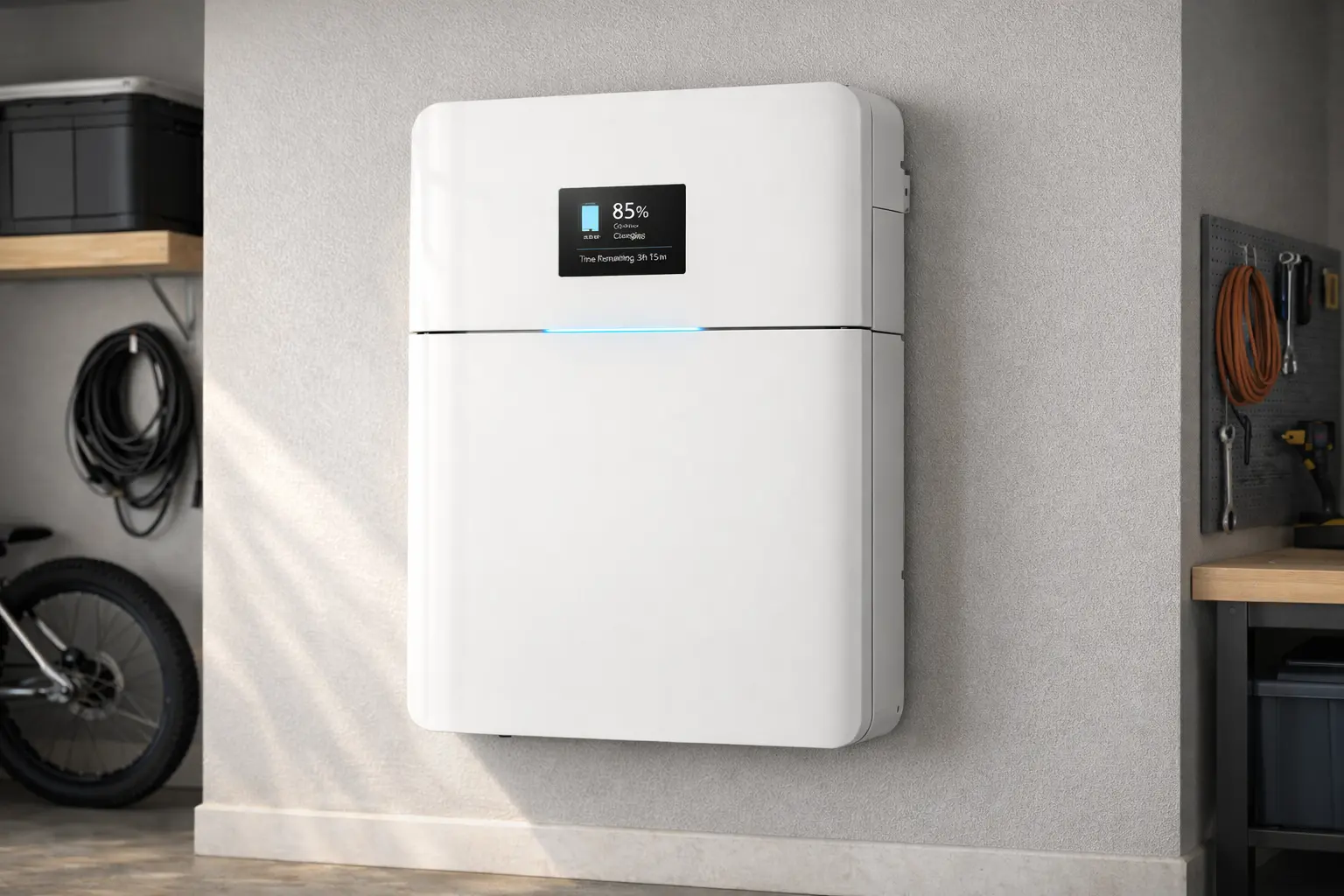
Lithium-Ion Advantages
- Long lifespan: 10–15 years or 3,000–6,000 charge cycles
- High efficiency: 90–95% round-trip
- Deep discharge: Safely use 80–100% of stored capacity (vs. 50% for lead-acid)
- Compact: Small wall-mounted footprint
- Zero maintenance: No servicing, no fluid checks
- Fast charging: Full charge in 2–4 hours from solar
- Smart features: App monitoring, TOU optimization, remote diagnostics
Every lithium home battery includes a Battery Management System (BMS) — the onboard electronics that protect cells from overcharging, over-discharging, and temperature extremes, enabling safe indoor installation without venting. Lead-acid doesn't use a BMS.
Lithium-Ion Disadvantages
- ✗Higher upfront cost: typically $8,000–$18,000 installed, depending on capacity and brand
- ✗Performance drops in extreme cold (below -4°F) or heat (above 122°F)
LFP vs NMC: Two Lithium Chemistries Explained
LFP and NMC — the two lithium chemistries used in residential storage — differ in safety, lifespan, and ideal use case.
LFP: safer, longer-lasting — best for warm climates or longevity. NMC: higher energy density in a smaller footprint — for tight spaces. For most homeowners, LFP wins on total value over 10–15 years.
Lead-Acid: The Budget Option
Lead-acid is the original rechargeable battery — the same chemistry that starts your car. Largely replaced by lithium in residential solar, it still suits off-grid and tight-budget situations. Two variants: Flooded (FLA) and Sealed (AGM/Gel) — meaningfully different in practice. Flooded means the lead plates sit in a free-flowing liquid electrolyte, vented to the outside as it charges. Sealed means that electrolyte is locked inside — either soaked into a fiberglass mat (AGM) or set into a gel — so nothing leaks out and nothing needs to vent.
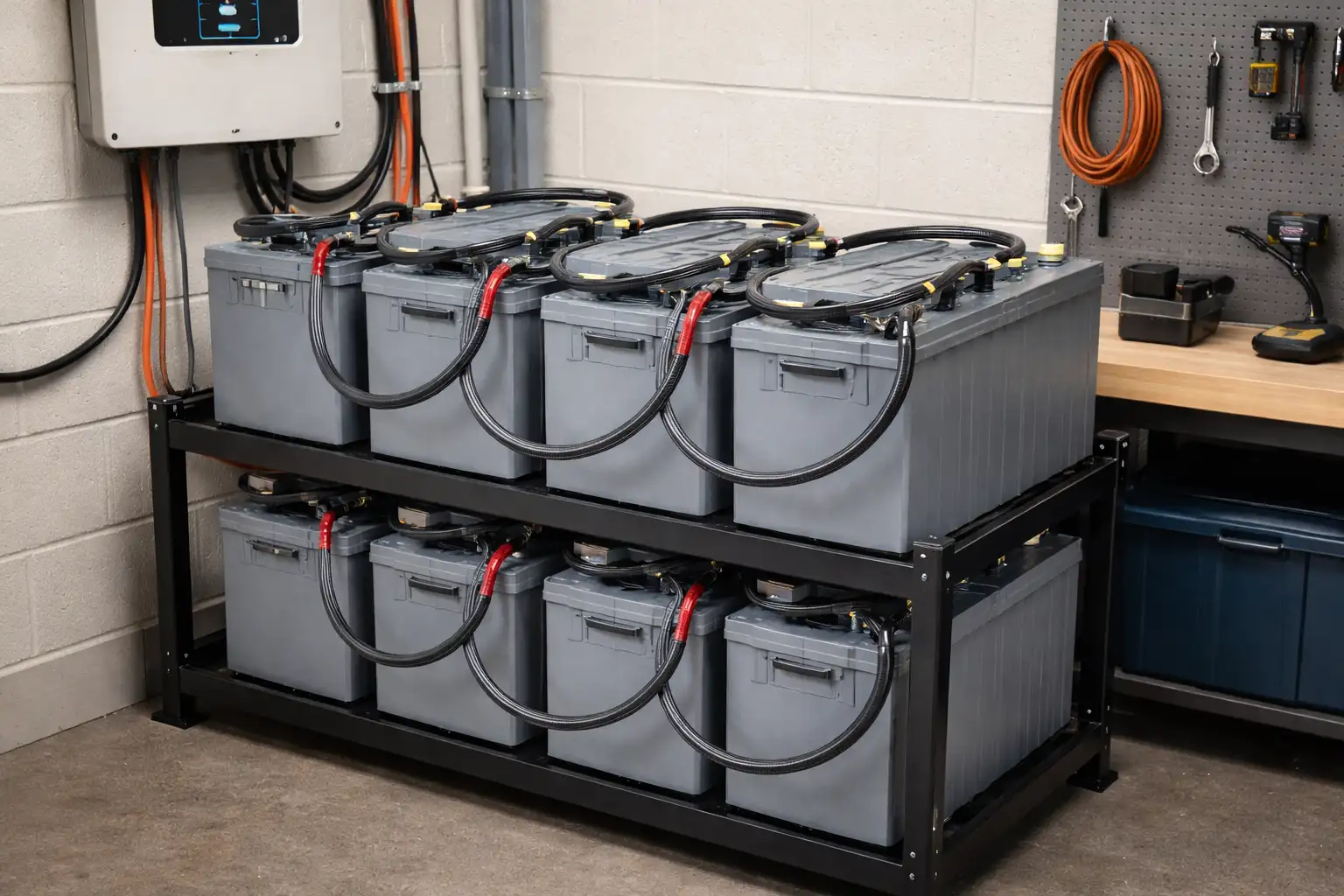
FLA vs AGM: FLA is cheaper but needs monthly cell watering and a ventilated space — miss one cycle and cells are permanently damaged. AGM/Gel is sealed, maintenance-free, and indoor-safe. For most homeowners, if choosing lead-acid, AGM is the right call.
Battery Types Full Comparison (2026)
This table uses AGM to represent lead-acid, since it's the safer, more common choice for home installs. Flooded (FLA) trails AGM on every row here — more maintenance, lower lifespan, and ventilation requirements — so it's covered separately above rather than repeated as a fourth column.
| Factor | Lithium-Ion (LFP) | Lithium-Ion (NMC) | Lead-Acid (AGM) |
|---|---|---|---|
| Installed cost (10 kWh) | $8,000–13,000 | $8,000–15,000 | $6,000–9,000 |
| Cost per usable kWh | ~$800–1,000/kWh | ~$900–1,100/kWh | ~$1,200–1,800/kWh* |
| Expected lifespan | 10–15 years | 10–15 years | 5–8 years |
| Cycle life | 5,000+ | ~3,000 | 800–1,200 |
| Round-trip efficiency | 92–95% | 90–95% | 70–80% |
| Usable capacity (DoD) | 80–100% | 80–100% | 50% |
| Self-discharge rate | <2%/month | ~3%/month | 5–15%/month |
| Operating temp range | -4°F to 131°F | -4°F to 122°F | 32°F to 104°F |
| Maintenance | None | None | None (AGM/Gel) |
| Hot climate suitability | Best (LFP) | Good | Limited |
| BMS included | Yes (integrated) | Yes (integrated) | No |
| Safety certifications | UL 9540, UL 9540A | UL 9540, UL 9540A | UL 1973 |
| Modular / expandable | Yes (most brands) | Limited | Bank-dependent |
| Size / weight | Compact | Compact | 2–3× larger |
| Smart app monitoring | Full | Full | Basic or none |
| 15-yr total lifecycle cost | Lowest overall | Low overall | Highest (2–3 replacements) |
*Lead-acid cost accounts for 50% DoD limit — a 10 kWh bank delivers only 5 kWh usably. See available incentives that can offset these costs, or start with the Battery Basics guide if you're new to home storage.
AC-Coupled vs DC-Coupled Battery Storage
How your battery connects to your solar system affects efficiency, cost, and compatibility. Your installer's recommendation depends on whether you already have solar panels.
AC-coupled means your solar inverter converts panel power to AC first, then a separate battery inverter converts some of that AC back to DC to charge the battery — and back to AC again when you use it: Solar → AC inverter → battery inverter (AC→DC→AC) → home. Each conversion wastes a little energy, but it's the easier way to bolt a battery onto solar you already have.
DC-coupled means the battery taps the panels' DC power directly, before any inversion: Solar → charge controller → battery → inverter → home. The battery stores raw DC and only one inverter converts it to AC, right when you actually use it — one fewer conversion than AC-coupled, which is why it's more efficient. The tradeoff: it usually requires a matched inverter, so it's the standard choice for new solar-plus-battery installs rather than retrofits.
Already have solar? AC-coupling works with any existing inverter and UL-listed battery. New solar + battery install? DC-coupling is more efficient — one inverter instead of two. Discuss coupling type and chemistry with your installer before signing.
Which Battery Type Is Right for You?
For most US homeowners in 2026, LFP lithium-ion is the right choice. Lead-acid is cheaper upfront but costs more long-term — 2–3 replacements over 15 years, with worse efficiency throughout. It only makes sense for an off-grid cabin or a temporary setup.
Pick NMC instead of LFP only if space is tight — it's more compact, but LFP wins on safety, lifespan, and heat tolerance.
For coupling: AC-coupled is simplest when adding a battery to existing solar. DC-coupled is more efficient and the better pick for a new solar-plus-battery install.
Not sure what size you need? Run your numbers with the Battery Sizing Calculator.
Look for UL 9540 certification — required by most jurisdictions for permitted residential installs. Always pull permits; if an installer skips them, walk away.
Top 2026 Battery Models
| Model | Chemistry | Capacity | Coupling | Installed Price |
|---|---|---|---|---|
| Tesla Powerwall 3 | LFP | 13.5 kWh | DC | ~$14,000 |
| Enphase IQ Battery 5P | LFP | 5 kWh | AC | ~$8,000 |
| LG RESU 16H Prime | NMC | 16 kWh | DC | ~$13,000 |
| Generac PWRcell | LFP | 9–18 kWh | AC | ~$18,000 |
| SolarEdge Home Battery | LFP | 9.7 kWh | DC | ~$9,500 |
Installed prices include battery, inverter, installation, permits, and 10-year warranty. Last updated May 2026.
Battery Types FAQ
A single 10–13.5 kWh lithium battery typically backs up essentials — fridge, lights, internet, and a few outlets — for 12–24 hours. Whole-home backup, including HVAC, usually needs 2–3 batteries stacked together (27–40+ kWh). An installer should size this based on your actual appliance loads, not a generic estimate.
DoD is how much of rated capacity you can safely use. Lithium: 80–100% DoD — a 10 kWh battery gives 8–10 kWh usably. Lead-acid: 50% DoD — the same 10 kWh battery gives only 5 kWh usably, doubling the real cost per kWh.
Most warranties guarantee ≥ 70% of original capacity after 10 years. For a 13.5 kWh Powerwall 3: ≥ 9.5 kWh usable after a decade. The warranty also covers manufacturing defects — not just capacity loss. It doesn't cover physical damage or flood damage. If it degrades faster than promised, the manufacturer must repair or replace it. Check: manufacturer-backed or third-party insurer? Manufacturer-backed is more reliable.
Not automatically. Lithium batteries need BMS communication (CAN bus or RS485) — not all inverters support this, so check compatibility before buying. Lead-acid needs a charge algorithm matched to the sub-type — flooded, AGM, and Gel each require different voltage profiles, and wrong settings permanently damage cells. Always confirm battery-inverter compatibility with your installer before signing.
Depends on the system. Modular LFP (Enphase IQ Battery, Generac PWRcell) lets you add modules later. Tesla Powerwall 3 stacks up to 4 units — best installed together. Lead-acid can expand but requires matched age and specs. Ask before choosing.
Lead-acid is the world's most recycled consumer product — over 99% recovered. Lithium recycling is expanding; Tesla, Enphase, and LG offer take-back programs, and several states mandate it. Sodium-ion is designed to be easier to recycle than lithium.
Possibly — but not yet. Sodium-ion avoids lithium and cobalt, uses abundant materials, and is entering mass production (CATL, BYD). Slightly lower energy density than LFP today. US residential products expected in 2–3 years. For today's purchase, LFP is the clear choice.
Neither is a realistic option for US homes in 2026. Vanadium flow batteries are built for commercial and utility scale — their cost ($1,500–2,000+/kWh) and tank footprint don't fit residential installs. Saltwater batteries lost their main manufacturer (Aquion Energy) to bankruptcy in 2017, and no viable home product exists today. Stick with lithium-ion or lead-acid.
Free Tools & Guides
Battery technology data sourced from U.S. DOE and manufacturer specifications. Last updated May 2026.