
Solar Incentives & Tax Credits 2026: Complete Guide
These solar incentives include a 30% federal tax credit covering your solar installation cost right now. Stack that with state rebates and your payback period can drop to 5-7 years. Here's every incentive available in 2026 and how to claim them.
Federal Solar Incentives: 30% Tax Credit Back on Everything
The federal Investment Tax Credit (ITC) gives homeowners a dollar-for-dollar reduction in federal taxes owed — not a deduction, a direct credit. You get back 30% of your total solar installation cost.
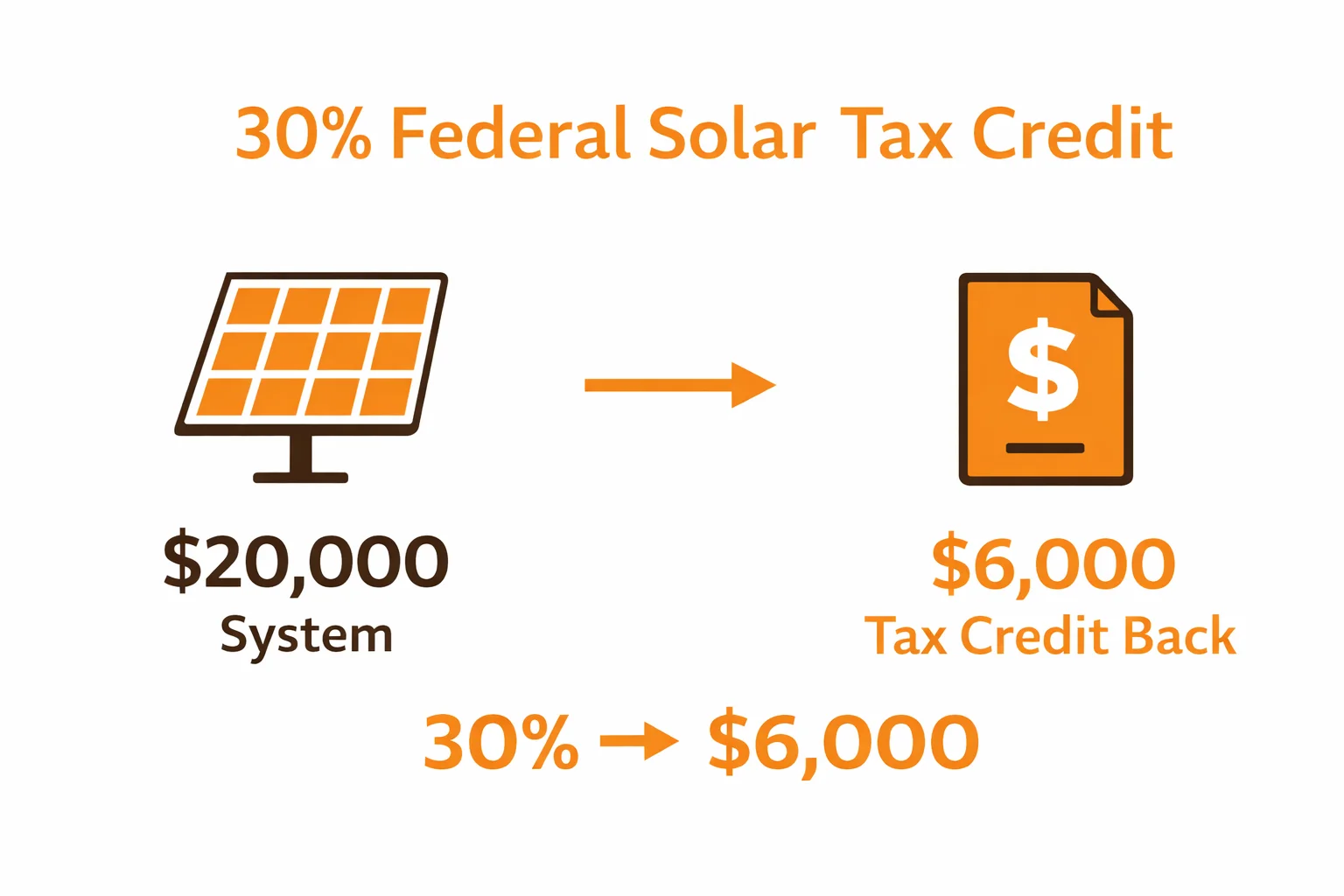
Real-world savings by system size:
- 4 kW system: ~$12,000 installed → $3,600 tax credit
- 6 kW system: ~$18,000 installed → $5,400 tax credit
- 7 kW system: ~$21,000 installed → $6,300 tax credit
- 10 kW system: ~$30,000 installed → $9,000 tax credit
The average American home installs a 6-7 kW system and saves $5,400-$6,300 from the federal credit alone — before any state or local incentives. Use our Solar Calculator to see your exact credit based on your location and electricity bill.
Who Qualifies for the Federal Solar Tax Credit?
- ✅ You own your home (renters cannot claim)
- ✅ System installed at your primary or secondary U.S. residence
- ✅ New equipment only (not used or refurbished)
- ✅ You owe federal income taxes
- ✅ System installed and operational between 2022-2034
Important: If you lease solar panels, the leasing company claims the tax credit — not you. Purchasing or financing your system always provides better long-term value than leasing.
What Costs Does the Credit Cover?
The 30% credit applies to your complete installation cost including:
- Solar panels and microinverters or string inverters
- All electrical components and wiring
- Installation labor and contractor fees
- Mounting hardware and racking system
- Battery storage systems (if charged by solar)
- Sales tax on all equipment
- Permitting and inspection fees
Adding a battery? The entire battery cost also qualifies for the 30% credit when installed with solar. A $13,500 Tesla Powerwall adds another $4,050 to your credit.
How to Claim the Solar Tax Credit
- Install your system and get it operational before December 31st of the tax year
- Save all receipts — total installation cost is what matters
- Complete IRS Form 5695 (Residential Energy Credits)
- Transfer the credit to Form 1040, Schedule 3, Line 5
- File your taxes by April 15 — the credit applies to that year's taxes
Pro tip: Unused credits roll forward indefinitely. If you owe $4,000 in taxes but your credit is $6,300, you use $4,000 this year and carry $2,300 forward to next year — you never lose it.
Federal Credit Timeline — Act Before It Drops
- 2022-2032: 30% ✅ — best time to install
- 2033: 26% — you lose 4% of your savings
- 2034: 22%
- 2035+: 0% (expires unless Congress renews)
State & Local Solar Incentives
On top of the 30% federal credit, many states offer their own programs that can save you thousands more. These stack with the federal credit — you claim both.
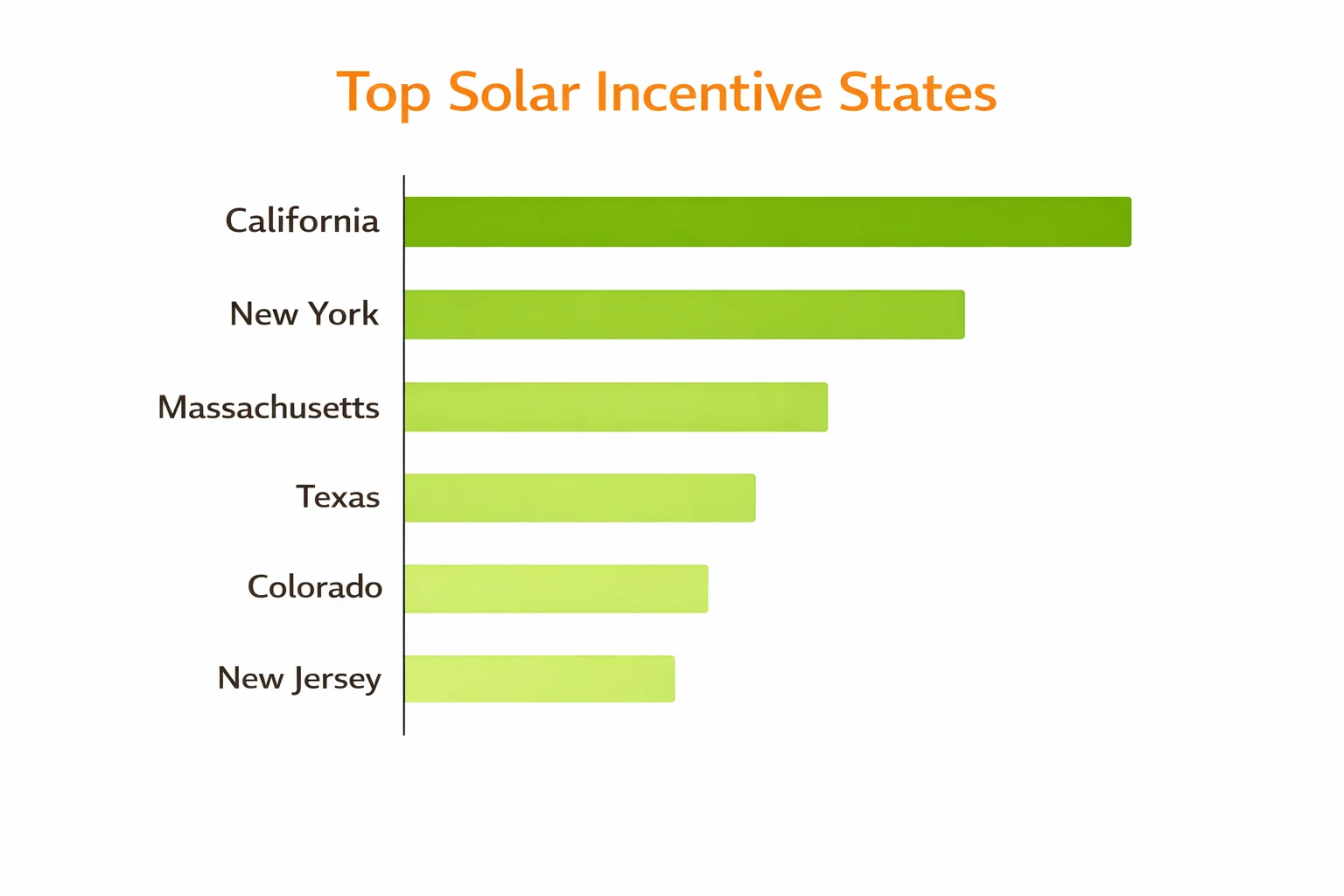
- California: SGIP (Self-Generation Incentive Program) — battery rebates up to $3,500. Net Energy Metering 3.0 for solar export credits.
- New York: State tax credit worth 25% of installation costs up to $5,000, plus the NY-Sun Megawatt Block incentive for additional per-watt rebates.
- Massachusetts: SMART (Solar Massachusetts Renewable Target) program pays monthly incentives per kWh generated. One of the best ongoing production incentives in the US.
- Texas: No state income tax means no state tax credit, but most Texas utilities offer property tax exemptions on solar — meaning your home value increases without higher taxes.
- New Jersey: SREC (Solar Renewable Energy Certificate) program pays you for every 1,000 kWh your system produces, plus state sales tax exemption on equipment.
- Colorado: State income tax credit plus utility rebates from Xcel Energy and other providers. Combined with federal credit, Colorado has some of the best stacked incentives nationally.
Find your state's current programs at the Department of Energy solar resources page.
Utility Company Rebates
Many electric utilities offer direct rebates of $0.20-$1.00 per watt installed. For a 7 kW system at $0.50/watt, that's an extra $3,500 off your installation cost — on top of the federal and state credits. Check with your local utility or use the DSIRE Incentive Database for programs in your area.
Property Tax Exemptions
Most states exempt solar installations from property tax assessments. Even though adding solar can increase your home's value by $15,000-$25,000, you won't pay higher property taxes on that added value. Check your state's specific rules — over 35 states currently offer this exemption.
Net Metering: Get Paid for Excess Power
When your solar panels produce more electricity than you use, net metering allows you to send that power to the grid and receive credit on your electric bill. In states with favorable net metering policies, you can virtually eliminate your electricity bill in sunny months and draw on those credits in winter. Your Solar Calculator accounts for net metering when estimating your annual savings.
How to Maximize Your Solar Incentives in 2026
Stack every available incentive: claim the 30% federal ITC, apply your state tax credit, submit utility rebate paperwork before installation, and check if your county offers property tax exemptions. Time your installation to ensure you owe enough federal tax to use the full credit — or spread it across two years.
Solar Incentives FAQ: Your Top Questions Answered
Can I claim the credit if I finance my system with a solar loan?
Yes. Cash purchases, solar loans, and home equity lines of credit all qualify for the full 30% federal tax credit. The key requirement is that you own the system. Solar leases and power purchase agreements (PPAs) do not qualify because you don't own the equipment.
What if the tax credit is larger than my federal tax bill?
The unused portion carries forward to future tax years indefinitely under current law. If you owe $3,500 in federal taxes but your credit is $6,000, you claim $3,500 this year and $2,500 next year. You never lose the credit.
Can I claim the credit for a vacation home or second property?
Yes — the federal credit applies to solar installed at a second home that you use personally. Rental properties may qualify for different business tax incentives. Consult a tax professional for rental property solar investments.
Is the solar tax credit refundable?
No. The ITC reduces your federal tax liability to zero but will not generate a refund if your credit exceeds your tax bill. The excess simply carries forward to the following tax year.
Do I need a professional installer to claim the credit?
No — DIY installations can qualify, but most homeowners use licensed contractors to ensure proper permitting, grid connection approval, and warranty coverage. Professional installation also provides documentation that simplifies the tax filing process.
Ready to calculate your total solar savings including all incentives?
Calculate My Solar Savings →