
Are Electric Cars Safe? Complete EV Safety Guide (2026)
This EV safety guide covers the biggest fears about EVs — fire, explosion after a crash, charging in rain — which are largely myths contradicted by data. Here's what actually happens, backed by real safety statistics.
EV Safety: The Real Fire Risk Data
The most persistent EV safety concern is battery fire risk. Here's what the National Transportation Safety Board data actually shows:
- Gas vehicles: 1,530 fires per 100,000 vehicles per year
- Electric vehicles: 25 fires per 100,000 vehicles per year
EVs catch fire 60 times less frequently than gasoline vehicles. The viral videos of burning EVs represent extraordinarily rare events — your gas car is statistically far more likely to catch fire than an EV.
When fires do occur, there's another important difference: EV battery fires typically develop slowly over 10-30 minutes with multiple warning stages — alerts, smoke, and gradual progression. A gasoline vehicle fire can engulf the entire car in under 2 minutes, giving occupants dramatically less time to exit safely.
What Is Thermal Runaway — And Can It Be Prevented?
EV batteries do not "explode" like a gas tank. The specific risk is called thermal runaway — a chain reaction where damaged or overheated battery cells generate heat faster than the cooling system can remove it, eventually leading to fire.
Thermal runaway can be triggered by: severe physical damage in a crash, manufacturing defects (extremely rare), extreme overcharging (prevented by the BMS), or prolonged exposure to extreme heat. Modern EVs have multiple independent systems designed to prevent thermal runaway from occurring and to contain it if it does start.
How EVs Prevent Battery Fires
Modern EVs use several independent, redundant safety systems working together to prevent and contain battery fires before they can start.
Battery Management System (BMS)
The Battery Management System is the brain of the battery pack. It monitors every individual cell in real time — tracking voltage, temperature, and state of charge thousands of times per second. If any cell approaches unsafe conditions, the BMS reduces power output, triggers cooling, and alerts the driver before any damage occurs. It also prevents overcharging and over-discharging, the two most common causes of lithium-ion battery degradation and failure.
Thermal Cooling System
EV battery packs use active liquid cooling systems — typically a glycol coolant flowing through channels between battery cells — to maintain the optimal operating temperature. This system prevents overheating during fast charging, hot weather driving, and extended high-performance use. It also warms the battery in cold weather to maintain efficiency and protect cells. The cooling system runs automatically without driver input.
Reinforced Safety Cage
The battery pack is encased in a reinforced steel and aluminum enclosure designed to survive crashes that total the rest of the vehicle. In NHTSA crash tests where test vehicles are completely destroyed, the battery pack typically remains structurally intact. Individual battery modules within the pack are also separated by fireproof barriers to prevent a single cell failure from spreading to adjacent cells.
Automatic Power Cutoff
In any significant crash, pyrotechnic disconnects sever the high-voltage circuit between the battery and the rest of the vehicle within milliseconds — faster than any manual switch could operate. This eliminates the risk of electrical current flowing through damaged wiring after a collision. The system triggers automatically via crash sensors, with no driver input required.
EV Safety Crash Ratings: What NHTSA Data Shows
EVs consistently earn the highest possible crash safety ratings — and the physics of their design explains why.
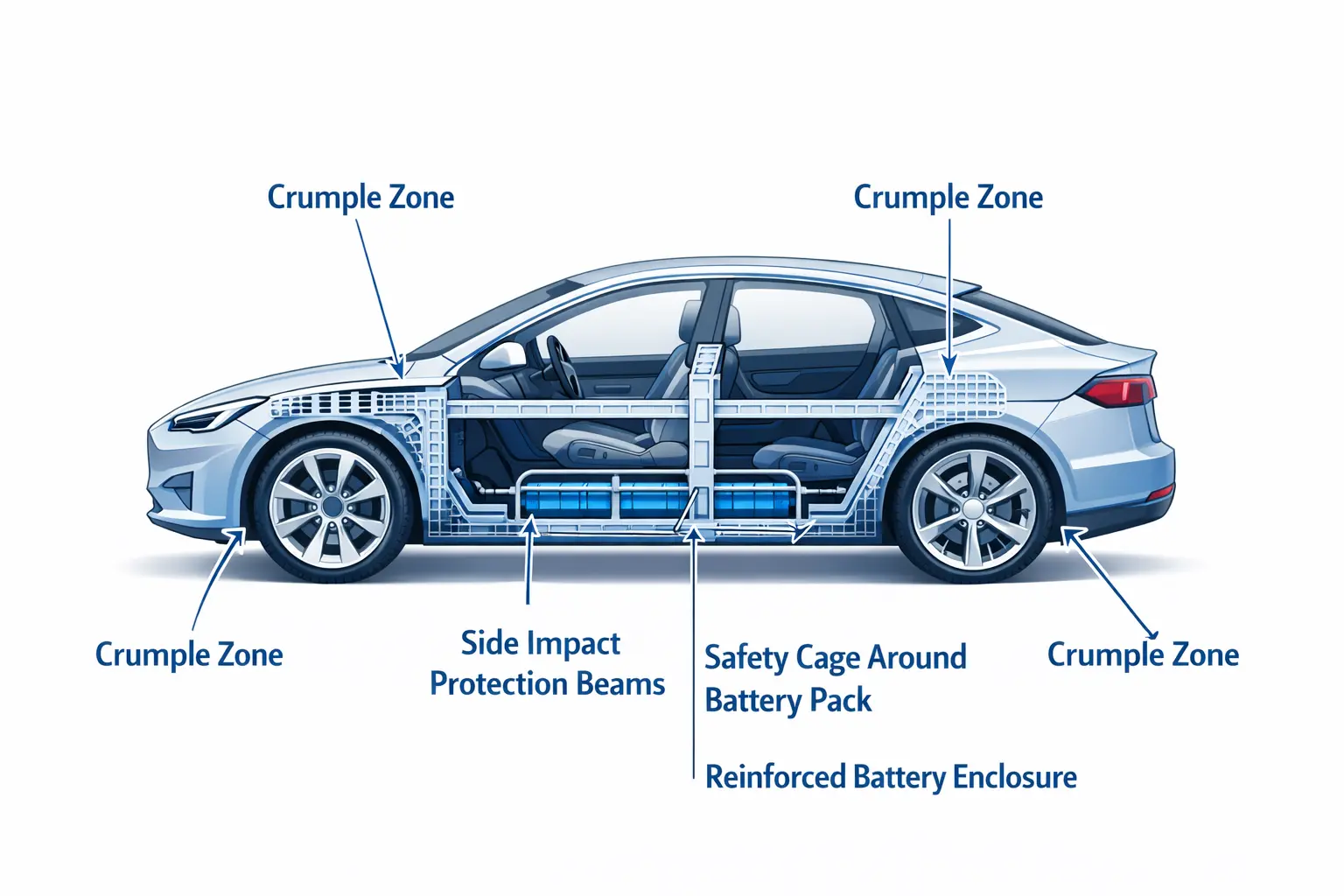
The Tesla Model 3 achieved the lowest probability of injury of any vehicle ever tested by NHTSA at the time of its rating. The Tesla Model Y, Ford Mustang Mach-E, Rivian R1T, and Hyundai Ioniq 6 all earned 5-star NHTSA ratings across all categories.
Why are EVs structurally safer than most gas vehicles?
- Low center of gravity: The heavy battery floor reduces rollover risk by 50%+ compared to similarly sized gas vehicles — the single most deadly crash type
- No engine in the front crumple zone: Without a bulky engine block, EVs have more space for front crumple zones to absorb crash energy before it reaches the occupant cabin
- Battery pack as structural backbone: The reinforced battery enclosure adds rigidity to the vehicle floor, strengthening the entire occupant cell
- Side impact protection: Additional reinforcement beams along the battery floor sides provide extra protection against side-impact intrusion
- Optimized weight distribution: Even front-rear weight balance improves handling and crash avoidance capability
Is It Safe to Charge in the Rain?
Completely safe. This is one of the most common EV misconceptions. All EV charging equipment — from the car's charging port to Level 2 home chargers to DC fast chargers — is designed and certified for outdoor use in all weather conditions.
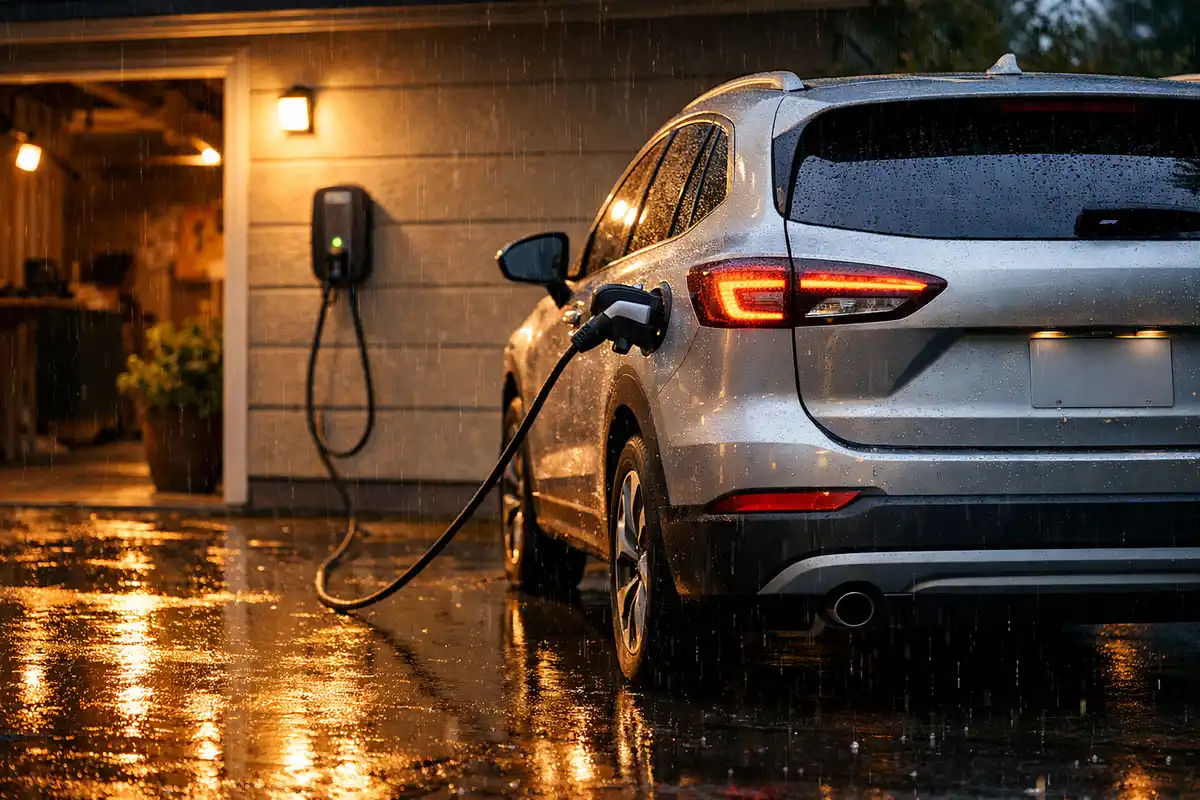
- EV charging ports use sealed, waterproof connectors that prevent any contact between water and electrical contacts
- Home Level 2 chargers are rated to NEMA 3R or higher — meaning they're waterproof and safe for outdoor installation
- The electrical connection between cable and vehicle is fully waterproofed by the connector seal and the vehicle's charging port door gasket
- Manufacturers test all charging systems in simulated monsoon conditions as part of standard certification
The laws of physics work in your favor here — electricity follows the path of least resistance through the sealed copper conductors, not through water or the car's exterior. You're no more at risk charging in rain than you are using any other IP-rated outdoor electrical device.
EV Safety FAQs: Your Top Questions Answered
Are EVs more dangerous in floods?
Not significantly more than gas cars. EV battery packs are sealed, waterproof enclosures. Driving through deep standing water is dangerous for any vehicle — water entering the engine air intake can destroy a gas car engine instantly. EVs are actually more tolerant of shallow water crossing. If flood water reaches the battery pack, have the vehicle inspected before driving again, just as you would any flood-damaged vehicle.
What happens if I'm charging when there's a power surge?
The onboard charger in every EV includes surge protection. Level 2 chargers also include circuit protection. A power surge during charging is handled by these protections — your battery management system limits incoming voltage and current regardless of what the grid sends.
Can an EV fire be put out with water?
EV battery fires do require large amounts of water to fully cool — sometimes thousands of gallons to prevent reignition of thermal runaway cells. Fire departments have EV-specific protocols for this. The critical context: EV fires start 60x less often than gas fires. When comparing EV fire risk to gas vehicle fire risk, EVs are significantly safer overall.
Are EVs safe in home garages?
Yes. EVs are no more dangerous to store in a garage than gas vehicles. Use a certified Level 2 charger with proper electrical installation, ensure the garage has normal ventilation (not airtight), and don't charge a visibly damaged battery after a significant accident. The same basic precautions apply to any vehicle in an enclosed space.
Do EVs get recalled for battery issues?
Yes, like any vehicle component. Notable recalls have occurred — most are software updates resolved over-the-air without visiting a dealer. Physical battery recalls are rare. NHTSA data shows EV recall rates are comparable to gas vehicles. Check your VIN at NHTSA.gov for any open recalls on your specific vehicle. For a full overview of how EVs work, see our EV Basics Guide.
Ready to see what an EV could save you?
Calculate My EV Savings →