
EV Incentives 2026: Complete Guide to Up to $7,500 Back
These EV incentives include up to $7,500 back from the federal government when you buy a qualifying electric vehicle — and since 2024, you can take that as an upfront price reduction at the dealership rather than waiting for tax season. Stack that with state rebates and you could save $10,000-$15,000 on a new EV.
Federal EV Incentives: Up to $7,500 Tax Credit for New EVs
The Inflation Reduction Act created the Clean Vehicle Credit — a federal tax credit of up to $7,500 for qualifying new electric vehicles. Starting in 2024, you have two options for claiming it:
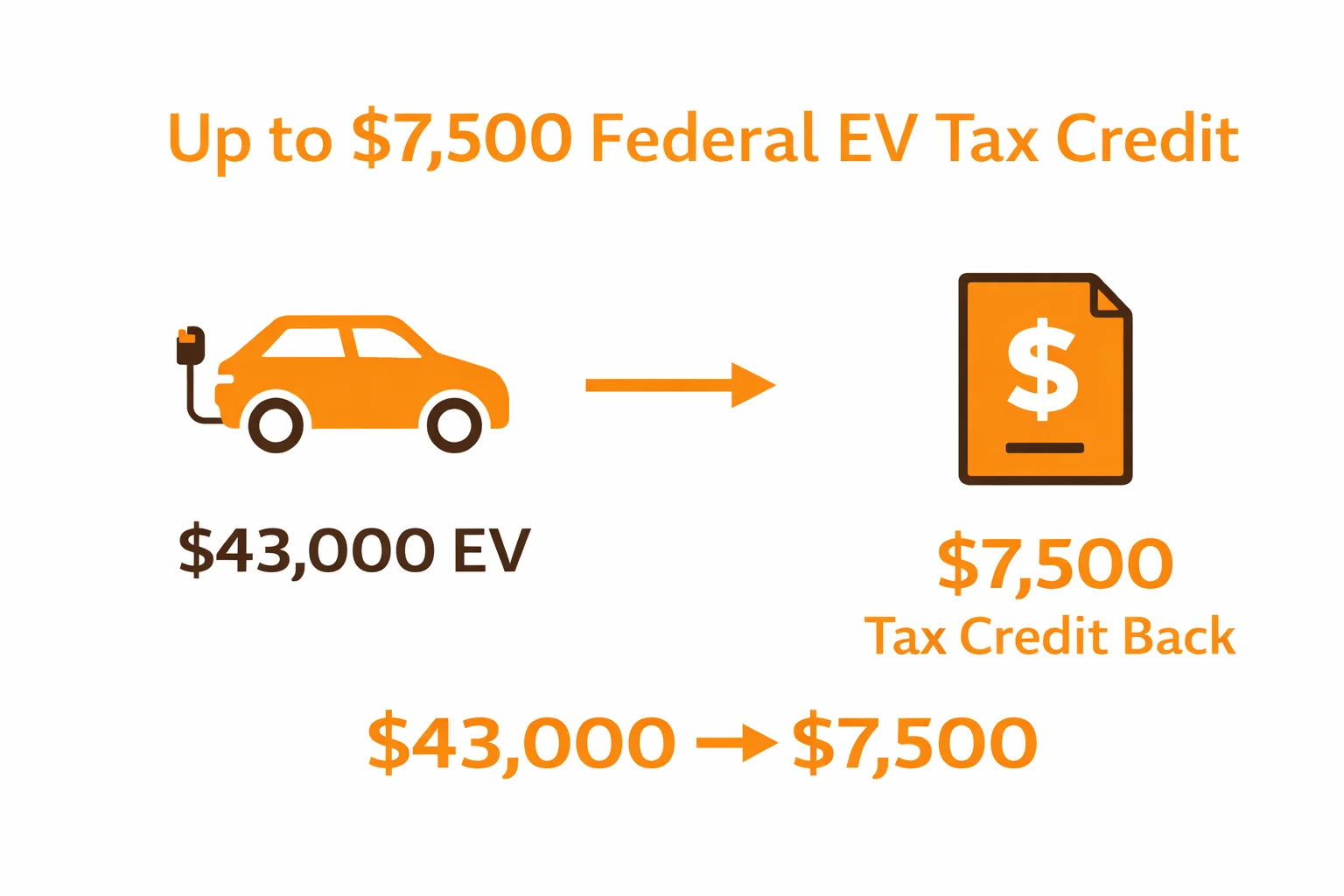
- Point-of-sale discount: Transfer the credit to the dealer and receive an immediate price reduction at purchase — no waiting for tax season
- Tax filing: Claim it when you file your federal tax return for the purchase year
New EV Eligibility Requirements
To qualify for the full $7,500 credit, both the vehicle and the buyer must meet requirements:
Vehicle requirements:
- MSRP under $55,000 for sedans, hatchbacks, and wagons
- MSRP under $80,000 for SUVs, trucks, and vans
- Final assembly in North America
- Battery minerals sourced from countries with US trade agreements (phasing in through 2027)
Buyer requirements:
- Modified adjusted gross income under $150,000 (single filer)
- Under $225,000 (head of household)
- Under $300,000 (married filing jointly)
- Cannot have claimed another clean vehicle credit in the prior 3 years
Check FuelEconomy.gov for the current list of qualifying vehicles — it updates as manufacturers certify compliance with the battery sourcing requirements.
Used EV Credit: Up to $4,000
Used EVs and plug-in hybrids qualify for a separate credit — the Previously Owned Clean Vehicle Credit:
- Credit amount: 30% of the sale price, up to $4,000 maximum
- Vehicle price must be under $25,000
- Vehicle must be at least 2 model years old at time of purchase
- Must be purchased from a dealer (not private seller)
- Income limits: $75,000 single, $112,500 head of household, $150,000 joint
This credit can also be transferred to the dealer as a point-of-sale discount. This makes EVs that previously seemed out of reach financially much more accessible.
Top State EV Incentives in 2026
State incentives stack on top of the federal credit. These are the strongest state EV programs in 2026:
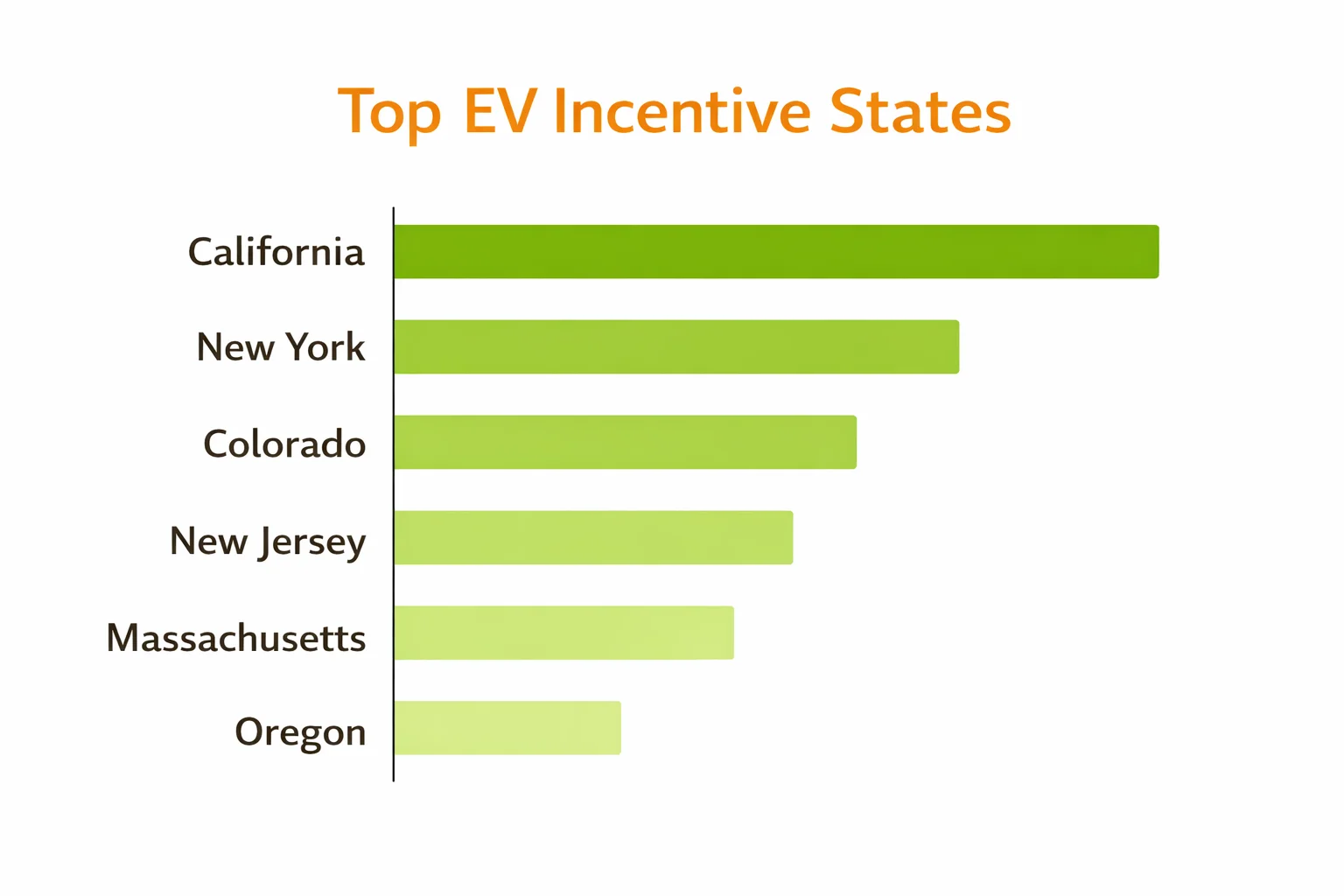
- California: Clean Vehicle Rebate Project (CVRP) offers rebates up to $7,500 for income-qualified buyers and $2,000 for standard-income buyers on eligible EVs. California also offers HOV lane stickers worth significant daily time savings, plus the Clean Cars 4 All program for low-income vehicle replacement.
- New York: Drive Clean Rebate provides up to $2,000 on eligible plug-in electric vehicles at participating dealers. New York also offers additional incentives through NYSERDA programs.
- Colorado: State EV tax credit of $5,000 for new EVs with MSRP under $35,000 — one of the most generous state credits in the country. Additional Xcel Energy rebates available for customers.
- New Jersey: Charge Up NJ program provides up to $4,000 rebate applied at point of sale at participating dealers. New Jersey also exempts EVs from state sales tax — saving another $1,500-3,000 on average.
- Massachusetts: MOR-EV (Massachusetts Offers Rebates for Electric Vehicles) provides $3,500 for vehicles with MSRP under $55,000. Income-qualified residents receive an additional $1,500 bonus.
- Oregon: Oregon EV Rebate of up to $2,500 plus the Oregon Clean Vehicle Rebate for income-qualified buyers provides up to $5,000 additional. Oregon also has no sales tax — saving $1,000-3,000 on purchase price.
Find programs specific to your state and utility at IRS EV Tax Credit Guide.
EV Charging Incentives: Federal & Utility Programs
Incentives aren't just for the vehicle itself — home EV charger installation also qualifies for federal and state programs:
- Federal charger tax credit: 30% of the cost of purchasing and installing a Level 2 home EV charger, up to $1,000. Claimed on IRS Form 8911.
- Utility rebates: Most major utilities offer $200-$500 rebates on Level 2 charger purchase and installation. Check with your specific utility company.
- Off-peak charging programs: Many utilities offer EV-specific rate plans with electricity as low as $0.05-0.08/kWh during overnight hours (typically 9 PM - 6 AM) — cutting your EV charging cost by 50-70% compared to standard rates.
Stacking Incentives: Real-World Examples
Colorado Example: Tesla Model 3 RWD ($40,240 MSRP)
- Federal tax credit: -$7,500
- Colorado state tax credit: -$5,000
- Xcel Energy rebate (if applicable): -$500
- Effective price: ~$27,240 — 32% off MSRP
California Example: Chevy Bolt EV ($26,500 MSRP)
- Federal tax credit: -$7,500
- CVRP rebate (standard income): -$2,000
- Effective price: ~$17,000 — 36% off MSRP
EV Incentives FAQ: Your Top Questions Answered
Can I get the credit as an upfront discount at the dealer?
Yes — since January 2024 you can transfer the federal credit to a participating dealer and receive it as an immediate price reduction. You don't need to owe federal taxes for this to work. The dealer receives the credit from the IRS and passes it to you at purchase.
Do state rebates stack with the federal credit?
Yes — they're completely separate programs. Federal, state, and utility incentives can all be combined. A Colorado Xcel Energy customer buying a qualifying EV could receive federal + state + utility incentives simultaneously.
What if I don't owe enough federal taxes to use the credit?
Take the credit as a point-of-sale discount at the dealer — it doesn't require any tax liability on your end. If you claim it on your tax return instead, unused amounts do not carry forward for the EV credit (unlike the solar credit).
Does leasing an EV qualify for the credit?
The leasing company receives the federal commercial clean vehicle credit, not you personally. However, many dealers pass this through as a reduced monthly payment or capitalized cost reduction. Ask specifically: "Are you passing through the EV tax credit in the lease price?" before signing.
Do plug-in hybrids (PHEVs) qualify?
Yes — qualifying PHEVs receive up to $3,750 (half the maximum credit). They must meet the same assembly and battery sourcing requirements as BEVs. Check FuelEconomy.gov for current qualifying PHEV models. For a full overview of EV types and how they work, see our EV Basics Guide.
Ready to calculate your complete EV savings?
Calculate My EV Savings →