
Solar Battery Types: Complete Technology Comparison Guide (2026)
Understanding your battery types is key — the technology you choose affects everything — upfront cost, lifespan, maintenance, and how much energy you can actually use. Here's a complete breakdown of every major battery type for home solar storage.
Lithium-Ion Battery Types: The Most Popular for Home Solar
Lithium-ion technology powers over 90% of new residential battery installations in 2026 — and for good reason. These batteries deliver the best combination of performance, lifespan, efficiency, and convenience available.
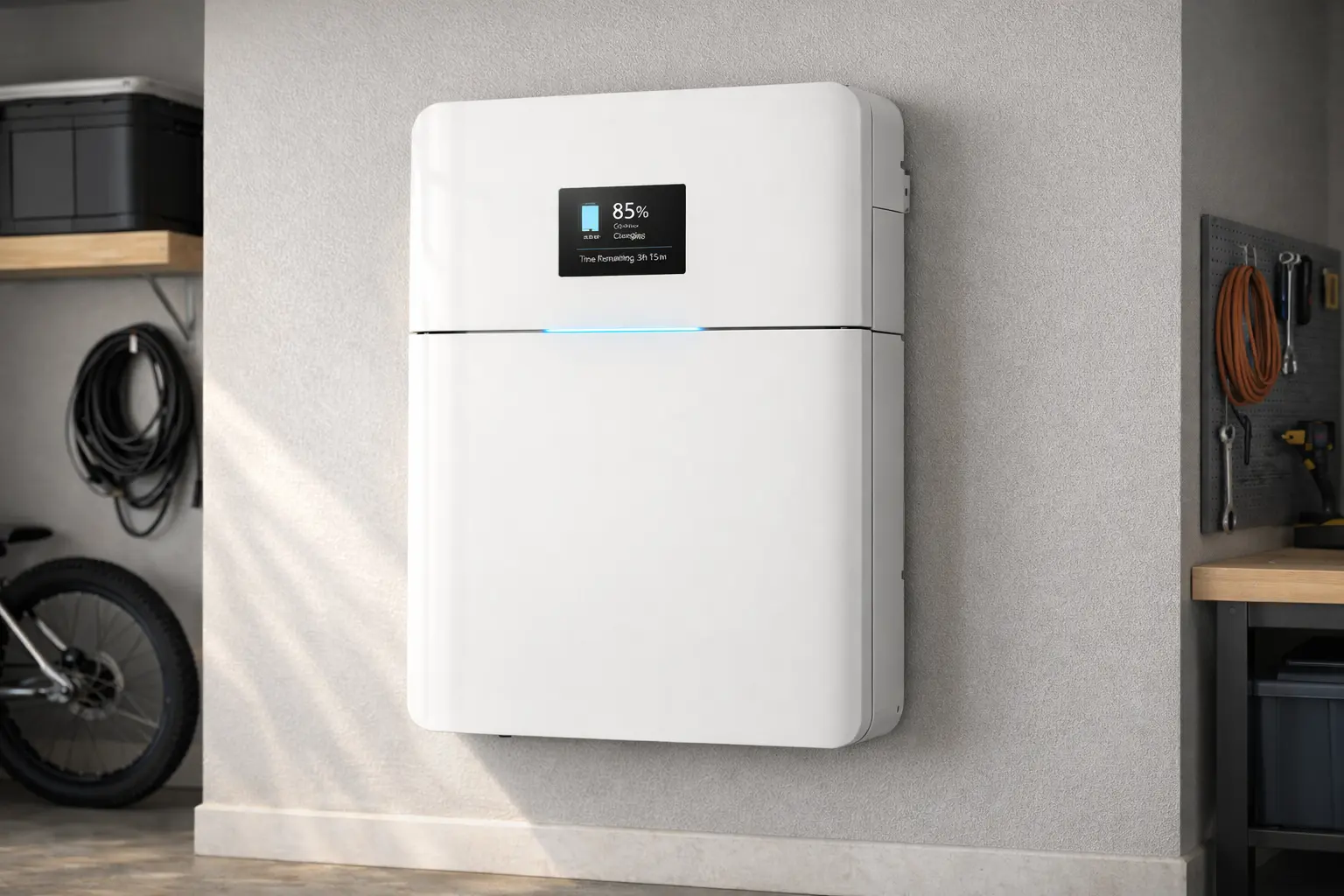
Two Main Lithium-Ion Chemistries
NMC (Nickel Manganese Cobalt): Higher energy density means more storage in less space. Widely used by Tesla Powerwall and LG RESU. Delivers maximum performance in a compact package. Slightly higher cost but preferred for premium installations.
LFP (Lithium Iron Phosphate): Safer chemistry with better thermal stability — significantly lower risk of thermal events. Longer cycle life (5,000+ cycles vs. 3,000 for NMC). Used by Enphase IQ Battery and increasingly popular across the industry. Excellent choice for homes in hot climates.
Lithium-Ion Advantages
- Long lifespan: 10-15 years or 3,000-5,000 charge cycles
- High efficiency: 90-95% round-trip — you get back 90-95¢ for every dollar of electricity you put in
- Deep discharge: Can safely use 80-100% of stored capacity
- Compact: High energy density means a small wall-mounted unit
- Zero maintenance: No servicing, no fluid checks, no manual cycling
- Fast charging: Full charge in 2-4 hours from solar production
- Smart features: App monitoring, automatic TOU optimization, remote diagnostics
- Silent operation: No fans, no noise — install anywhere in your home
Lithium-Ion Disadvantages
- Higher upfront cost: $8,000-$15,000 installed depending on capacity
- Performance degrades in extreme temperatures (below -4°F or above 122°F)
- Loses approximately 2-3% capacity per year over time
Popular 2026 lithium models:
- Tesla Powerwall 3 — 13.5 kWh | ~$11,000 installed
- Enphase IQ Battery 5P — 5 kWh | ~$8,000 installed
- LG RESU 16H Prime — 16 kWh | ~$12,500 installed
- Generac PWRcell — 9-18 kWh modular | ~$10,000-15,000
Lead-Acid Battery Types: The Budget Option
Lead-acid is the original rechargeable battery technology — the same chemistry that starts your car. While largely replaced by lithium in residential solar, lead-acid still makes sense for specific situations like off-grid cabins and budget-constrained setups.
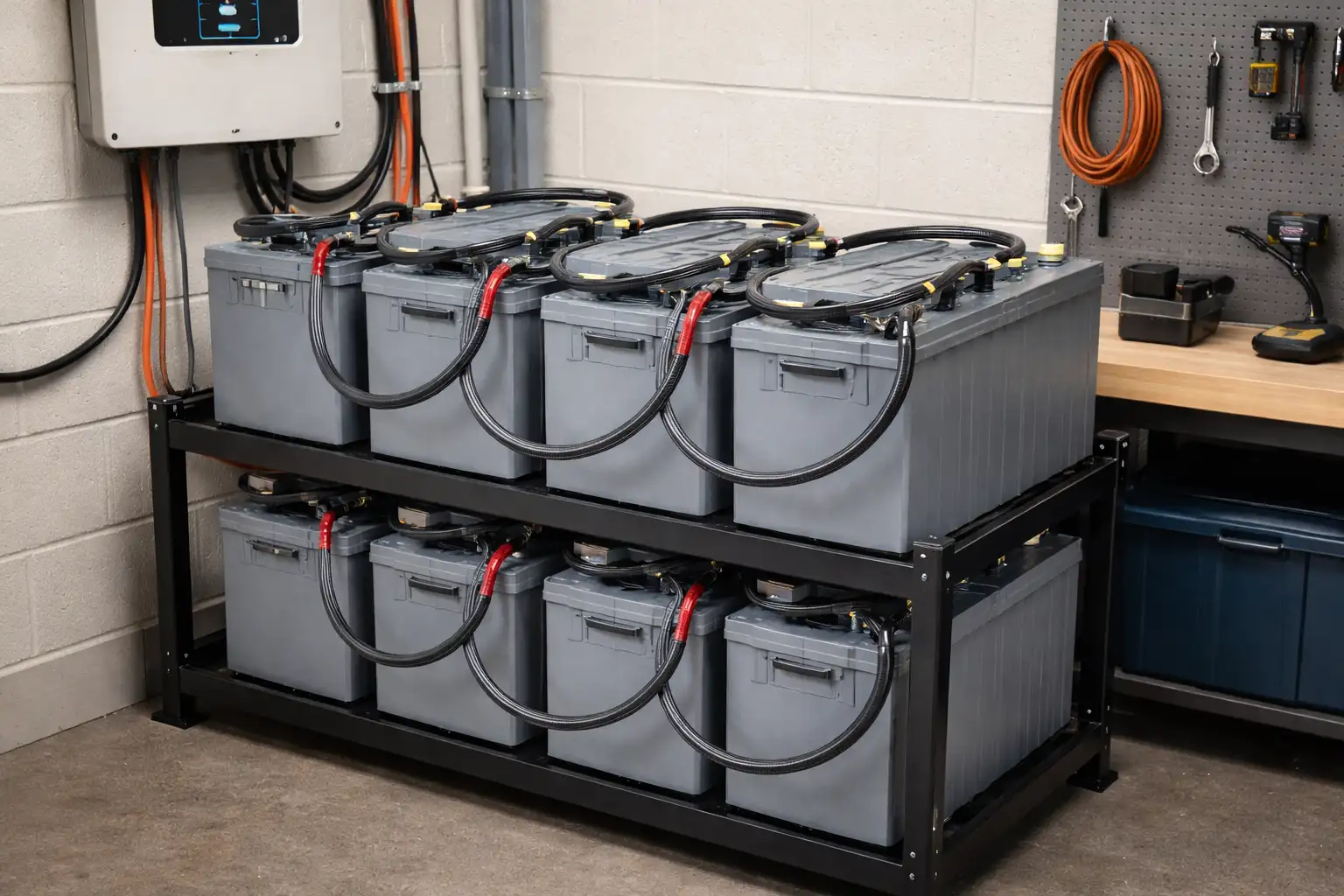
Two Lead-Acid Types
Flooded Lead-Acid (FLA): The original and cheapest option. Requires adding distilled water every 1-3 months, must be installed in a ventilated space (releases hydrogen gas during charging), and has the shortest lifespan of any solar battery at 3-7 years. Only viable for off-grid setups where cost is the primary constraint.
Sealed Lead-Acid — AGM/Gel: Maintenance-free sealed design that can be installed indoors. AGM (Absorbent Glass Mat) handles high charge/discharge rates well. Gel batteries perform better in high temperatures. Both last 5-8 years — still significantly shorter than lithium. Cost is moderate at $6,000-$9,000 installed.
Lead-Acid Advantages
- Low upfront cost — 40-60% cheaper than lithium for the same nominal capacity
- Proven 150-year-old technology, extremely well-understood
- 99% recyclable — the most recycled consumer product in the world
- Tolerates wider temperature range than lithium
- No fire risk from thermal runaway (unlike NMC lithium)
Lead-Acid Disadvantages
- Short lifespan: 3-8 years vs. 10-15 for lithium — often need 2-3 replacements over a system's life
- Limited usable capacity: Only safely discharge to 50% to preserve lifespan — a 200 Ah battery only gives you 100 Ah usably
- Low efficiency: 70-80% round-trip — waste 20-30% of stored energy as heat
- Heavy and bulky: 2-3x larger and heavier than equivalent lithium — requires significant floor space
- Slow charging: Full charge takes 6-12 hours
- Flooded types require maintenance: Regular water additions and ventilation
Battery Types Compared: Lithium vs Lead-Acid
- Upfront cost: Lithium $8,000-15,000 | Lead-Acid $4,000-9,000
- Lifespan: Lithium 10-15 years | Lead-Acid 3-8 years
- Total lifecycle cost: Lithium often cheaper over 15 years after accounting for replacements
- Round-trip efficiency: Lithium 90-95% | Lead-Acid 70-80%
- Usable capacity: Lithium 80-100% | Lead-Acid 50%
- Maintenance: Lithium none | Lead-Acid regular (flooded) or none (sealed)
- Size: Lithium compact wall-mount | Lead-Acid 2-3x larger floor-mount
- Smart features: Lithium full app integration | Lead-Acid basic or none
- Federal tax credit: Both qualify for 30% — see our Battery Incentives Guide
Which of These Battery Types Is Right for You?
Choose Lithium-Ion If:
- You want backup power for your home with maximum reliability
- You're pairing with solar panels for daily charge-discharge cycling
- You want zero maintenance for 10+ years
- Space is limited (garage, utility closet)
- You want smart features and app monitoring
- You're in a hot climate (LFP chemistry especially)
Consider Lead-Acid If:
- You have a very tight budget and basic backup needs
- It's a remote off-grid cabin used only occasionally
- It's a temporary installation (under 5 years)
- You have experience maintaining flooded batteries
For most homeowners, lithium-ion delivers better long-term value even at higher upfront cost. Over 15 years, you'd likely replace lead-acid batteries 2-3 times — spending more in total while getting worse performance throughout. Compare all battery types side by side using our Battery Sizing Calculator. For official guidance on home energy storage, see the U.S. Department of Energy battery storage guide. New to home battery storage? Start with our Battery Basics Guide for a full overview before sizing your system.
Battery Types FAQ
Can I mix lithium and lead-acid batteries?
No. Mixing battery chemistries in the same system causes serious damage to both battery types. Always use the same chemistry, brand, and ideally the same age of batteries together.
Do lead-acid batteries work with any solar inverter?
Most solar inverters work with lead-acid batteries, but you must configure the charge settings correctly for the specific chemistry (flooded vs. AGM vs. gel). Lithium batteries require inverters with lithium-compatible BMS communication.
What happens to old solar batteries?
Lead-acid batteries are 99% recyclable and have an established recycling infrastructure. Lithium batteries are increasingly recycled, with most manufacturers offering take-back programs at end of life.
Not sure how much battery storage you need?
Find My Battery Size →