
Battery Incentives & Tax Credits 2026: Complete Guide
These battery incentives include the same 30% federal tax credit as solar for home batteries — plus state rebates that can cover another $300-$1,000 or more depending on where you live. Here's every incentive available for battery storage in 2026 and how to stack them for maximum savings.
Federal Battery Storage Tax Credit: 30% Back
The Inflation Reduction Act expanded the federal tax credit to cover standalone battery storage starting January 1, 2023. This is a direct dollar-for-dollar reduction in federal taxes owed — not a deduction from income.
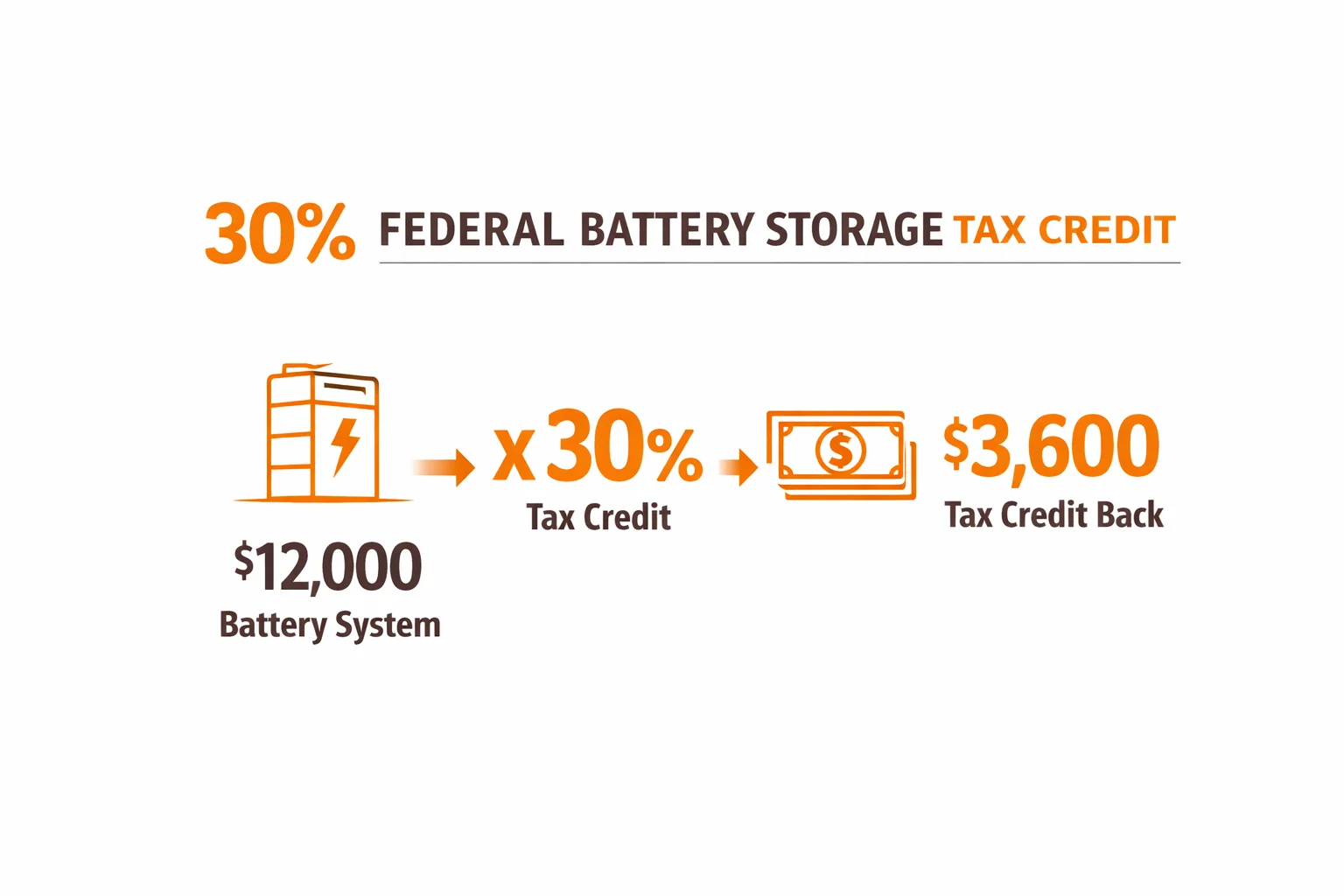
Real savings by system size:
- $10,000 battery system: $3,000 back
- $12,000 battery system: $3,600 back
- $14,000 battery system: $4,200 back
- $15,000 battery system: $4,500 back
Who Qualifies?
- ✅ You own your home
- ✅ Battery capacity is 3 kWh or larger (all major home batteries qualify)
- ✅ Installed at your U.S. primary or secondary residence
- ✅ You owe federal income taxes
- ✅ New equipment only — no used or refurbished batteries
- ✅ Installed between January 1, 2023 and December 31, 2034
No solar required. This is the biggest change from previous rules. Standalone batteries installed after January 1, 2023 qualify for the full 30% federal credit even with no solar panels on your roof. Want to understand battery options before deciding? See our Battery Basics Guide.
Claiming the Credit
- Install your battery system and ensure it's operational in the tax year
- Save all invoices showing the total installed system cost
- Complete IRS Form 5695 (Residential Energy Credits)
- Transfer credit to Form 1040, Schedule 3
- File by April 15 — unused credit carries forward indefinitely
Credit Timeline
- 2023-2032: 30% ✅ — maximum savings
- 2033: 26%
- 2034: 22%
- 2035+: 0% unless renewed by Congress
State Battery Incentives: Top Programs in 2026
State programs stack on top of the federal credit — you claim both. Here are the leading state programs in 2026:
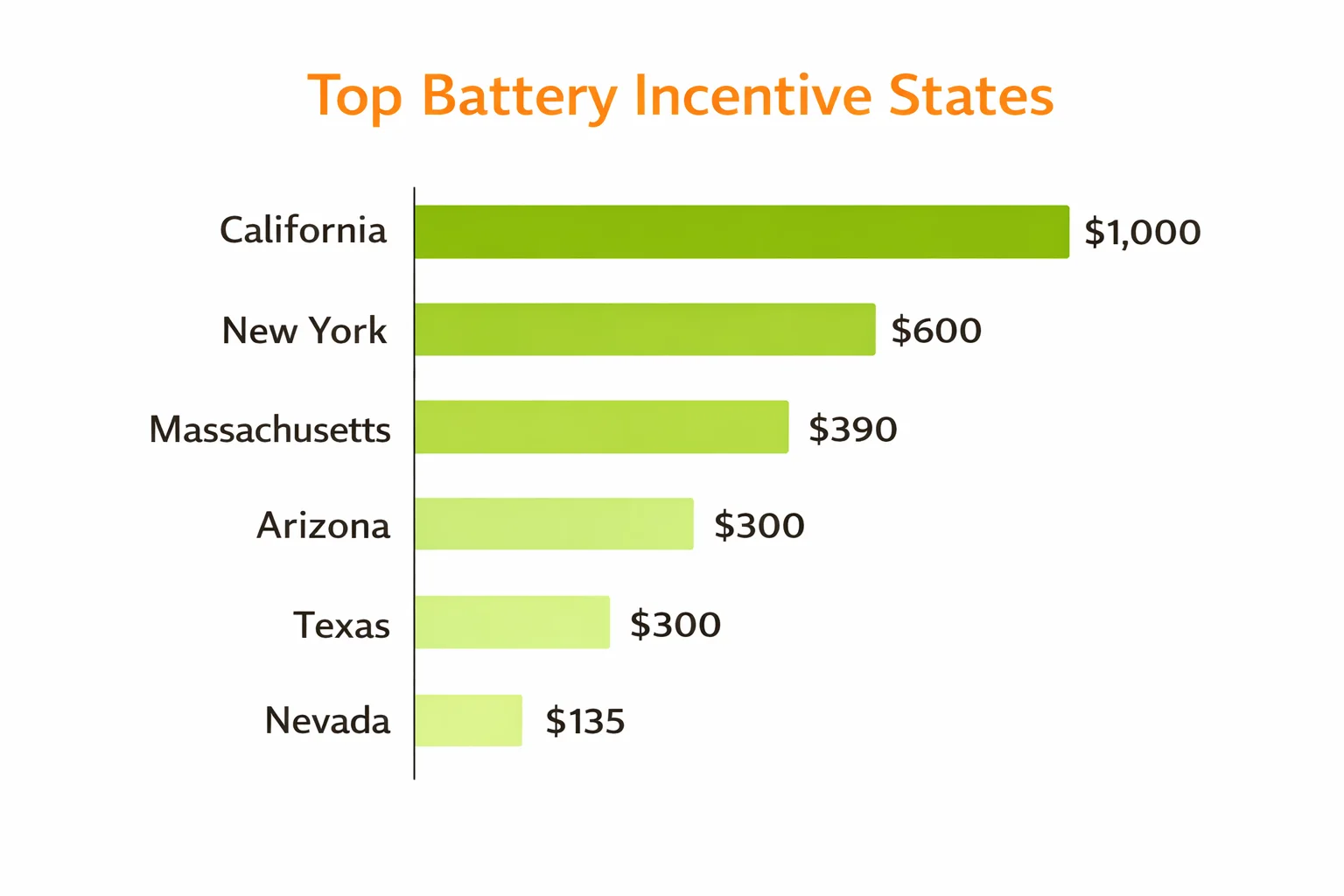
- California — up to $1,000+: The Self-Generation Incentive Program (SGIP) offers rebates based on battery capacity. Income-qualified households (SGIP Equity) receive significantly higher amounts — sometimes $3,000-$5,000+ for the same system. One of the strongest battery incentive programs in the country.
- New York — up to $600: The NY-Sun Incentive Program and Con Edison/National Grid programs provide per-kWh rebates for battery storage. Amounts vary by utility territory and capacity.
- Massachusetts — up to $390+: The ConnectedSolutions program pays customers to dispatch their batteries during grid stress events. This creates ongoing annual revenue on top of the upfront rebate.
- Arizona — up to $300: APS (Arizona Public Service) and SRP (Salt River Project) offer battery storage rebates for their customers. Program availability varies by enrollment period.
- Texas — up to $300: Oncor and CPS Energy offer battery rebates in their service territories. Texas also has strong TOU rate plans where battery arbitrage can save $500-$1,000/year.
- Nevada — up to $135: NV Energy offers battery storage rebates through their demand response program.
Find current programs and amounts in your state at Energy.gov.
Utility Demand Response Programs
Many utilities pay battery owners to participate in demand response — automatically discharging your battery during grid peak periods to reduce strain. These programs pay $50-$300 per year in ongoing compensation, turning your battery into a revenue-generating asset. Massachusetts ConnectedSolutions is the leading example, but programs exist in California, New York, and other states.
Solar + Battery: The Maximum Incentive Stack
Installing a battery alongside solar panels maximizes your total incentives:
- The combined system cost (panels + battery) all qualifies for the 30% federal credit
- A $35,000 combined system generates a $10,500 federal credit
- Single installation saves on labor, permitting, and electrical work
- Some state programs offer enhanced rebates for solar+battery bundles
- Adding a battery later means a second installation cost and potentially different incentive rules
See our Solar Incentives Guide for how federal credits work on the full combined system. Use our Battery Sizing Calculator to see your total system savings.
How to Maximize Your Battery Incentives
1. Stack Every Available Program
Federal credit + state rebate + utility rebate + demand response enrollment = maximum total savings. A California homeowner could receive: 30% federal credit ($3,600 on $12,000 system) + SGIP rebate ($1,000+) + potential PG&E demand response payments ($50-150/year) — reducing net cost by 40-50%.
2. Check Income-Qualified Programs
California's SGIP Equity program, New York's EmPower+, and several utility programs provide significantly higher incentives for lower and moderate income households. Income-qualified California residents can receive battery systems at little to no out-of-pocket cost through stacked programs.
3. Install Before Rate Changes
Many state programs operate on a first-come, first-served enrollment basis and close when funding runs out. California's SGIP has historically run out of standard funding mid-year. Apply early in the year for best availability.
Battery Incentives FAQ
Can I claim the credit if I finance the battery with a loan?
Yes. Solar loans, personal loans, and home equity lines of credit all qualify. You must own the battery system — lease arrangements do not qualify for the homeowner credit.
What if the federal credit exceeds my tax bill?
The unused portion carries forward indefinitely. If you owe $2,500 in taxes but your credit is $3,600, you use $2,500 this year and $1,100 the following year.
Do utility rebates reduce my federal credit?
Utility rebates typically reduce your net system cost, which reduces the amount eligible for the federal credit. However, state tax credits do not reduce your federal credit basis. The order matters: calculate your federal credit on the full installed cost before utility rebates.
Can I claim the credit for a battery at a second home?
Yes — the credit applies to batteries at primary and secondary residences you use personally. Rental properties may qualify for different business energy credits. Consult a tax professional for investment properties.
Ready to see your total battery cost after all incentives?
Find My Battery Size →